

In regions with cold climates around the world, architectural design typically separates individuals from harsh weather conditions. However, this concept can be traced back to European colonialism. On the contrary, the Indigenous, Inuit and Métis communities, known collectively as Aboriginal people in Canada, prioritise blending structures with nature. These communities have deep historical connections to their natural surroundings, which are often viewed as outdated or antiquated ways of life. However, the construction of community, cultural and heritage centers for Aboriginal people in the past two decades demonstrates that their way of life can foster a deeper appreciation for the environment throughout all seasons. Aboriginal architecture is characterised by distinct features, such as exposed wood, semi-open walls, curves that contrast with the sharp 90-degree angles of Western designs, and large horizontal roofs that ground the structures closer to the earth. In addition, many recent Aboriginal community centres incorporate aspects of the surrounding natural environment, reflecting a style known as biophilic design. Biophilic architecture is not simply the incorporation of natural elements but rather an innate human need to reconnect with nature. Although the concept of biophilic design is relatively new to Western architecture, it bears similarities to many traditional Aboriginal designs, which are integral to the concept of Traditional Knowledge discussed by architectural historian Grant Fahlgren. For Aboriginal communities, the struggle between their Traditional Knowledge and colonial building shapes has been ongoing for several centuries. However, over the past 25 years, as these communities have witnessed the adverse effects of climate change on their traditional land, they have increasingly embraced the use of Traditional Knowledge in architectural design, not only for the benefit of their own communities but also for the well-being of the Canadian landscape as a whole.
Over the last few decades there has been an increase in the number of Aboriginal-inspired community centres designed. Although earlier structures were hesitant to embrace Aboriginal concepts, recent designs have produced the most powerful examples of Traditional Knowledge structures to date. This essay will analyse five of these Aboriginal community structures in different regions of Canada that experience freezing temperatures during winter. During the cold seasons in Canada, Aboriginal community centres offer an environment that connects visitors with nature. Despite the challenges faced by Aboriginal communities in gaining recognition and the dominance of colonialist cold climate architecture, Aboriginal community centres present an alternative approach to constructing structures for winter. This essay aims to demonstrate, through formal analysis and a postcolonial perspective, that Aboriginal community centres do not adopt Western aesthetic principles, but rather incorporate natural elements to create a fusion between the body and the structures.
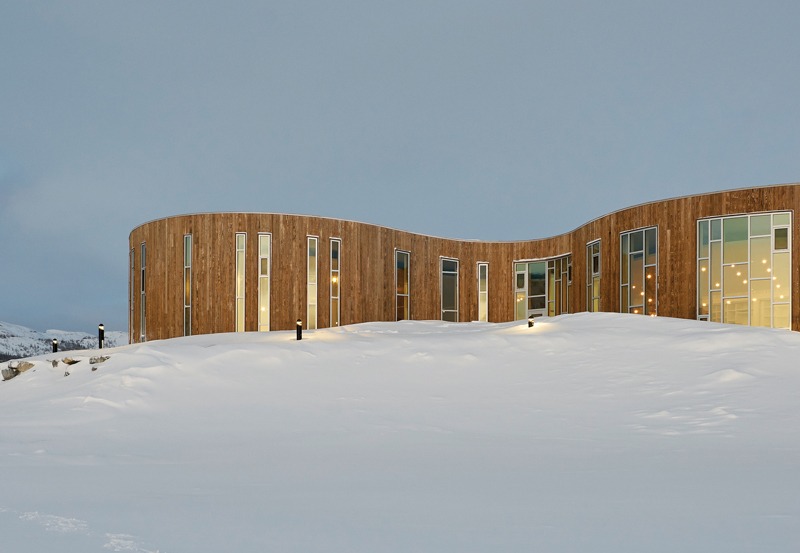
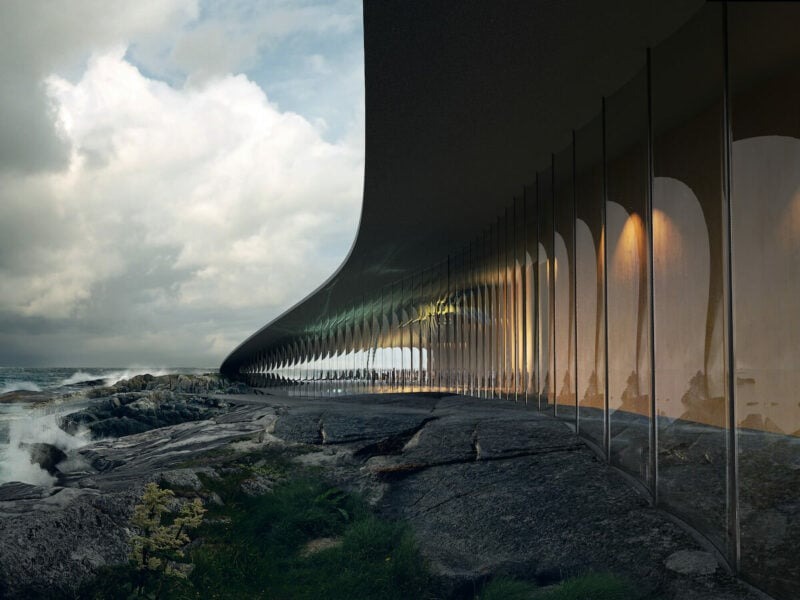
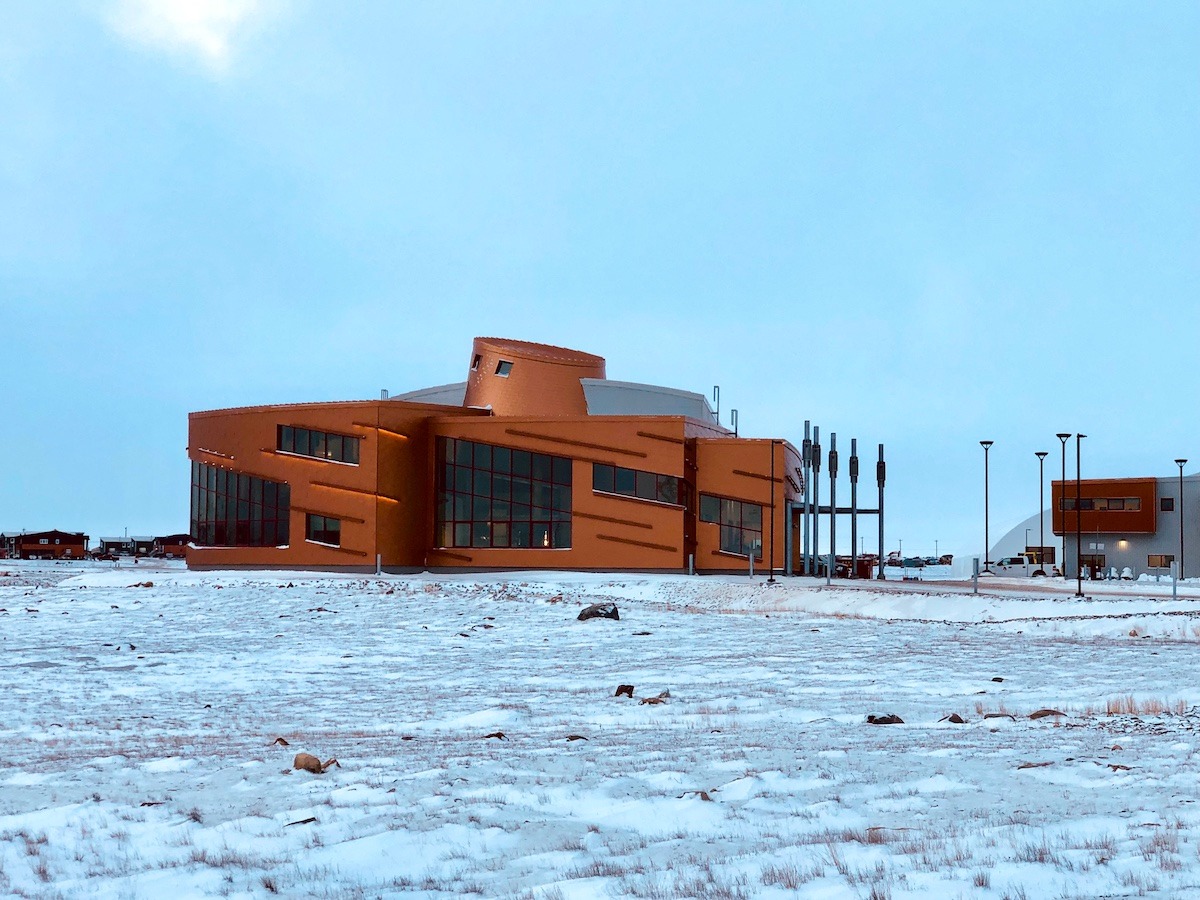
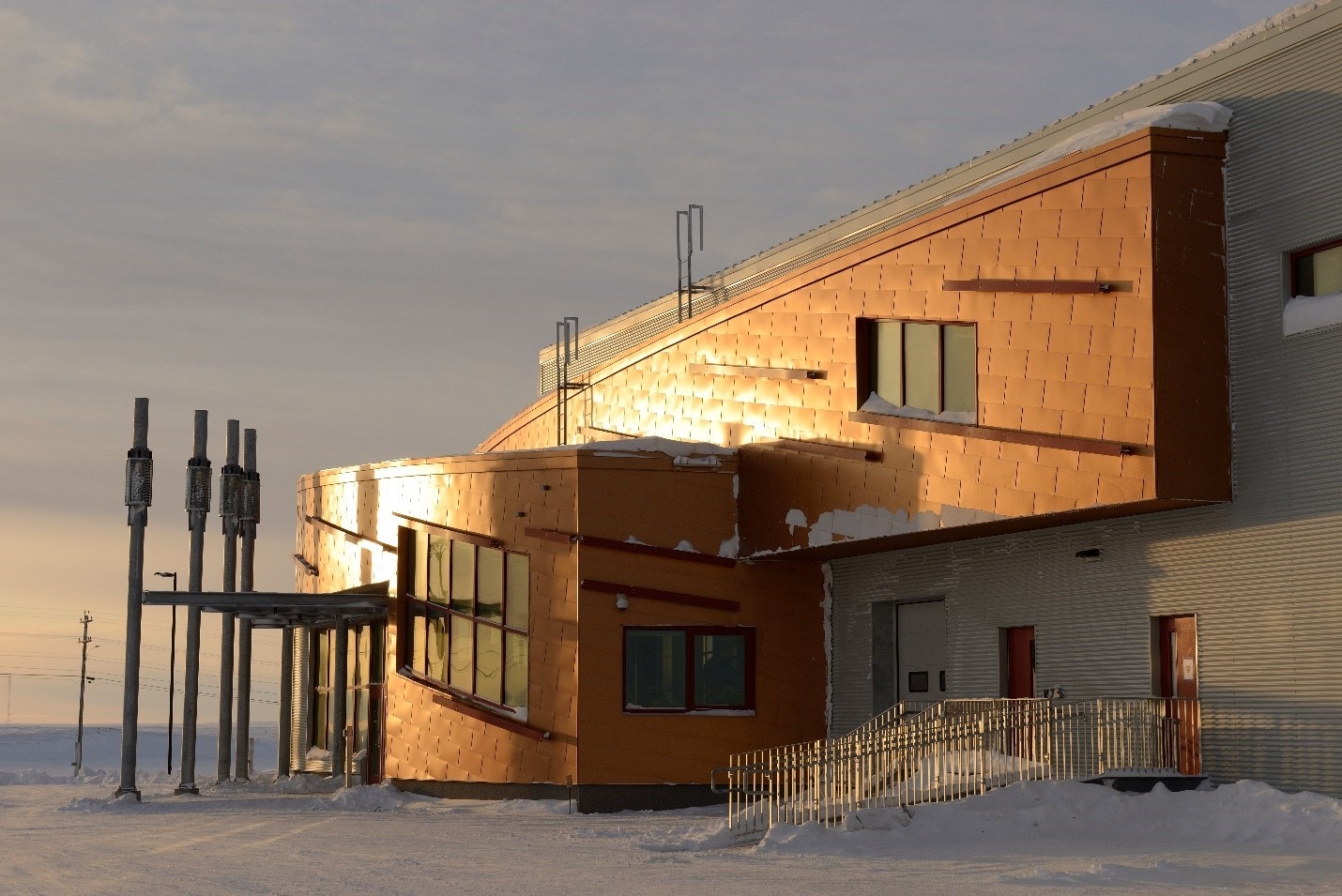
EVOQ Architects. “Outside View of the Canadian High Arctic Research Station at Sunset.” 2019, Cambridge Bay, Nunavut.
Biophilic Design
Biophilic design often incorporates elements that resemble the natural world, including textures, colours, shapes, and materials that offer an indirect connection to nature. In Aboriginal design, this technique of biomimicry serves as a bridge to nature, rooted in evolution and known through Traditional Knowledge. By incorporating natural materials into these community centres, a generation of knowledge of the body is fostered, highlighting the traditional connection each community has with its ancestral environment. These contemporary Aboriginal centres uses colour, materials, and shapes that mimic nature, enabling individuals to continuously feel a part of the natural world while in or around the structure. Materials and colours can emphasise native plants and animals, shapes help blend structures into the environment, and the incorporation of natural elements such as vegetation, water, snow, and ice reinforce the appreciation of the land.
Natural designs emphasise the importance of nature and Traditional Knowledge in each structure by incorporating biomimicry into the materials used to remind the body of the traditional environment associated with the Aboriginal community. In the past, Inuit communities built temporary seasonal structures using locally sourced resources, often incorporating wood supports and stone foundations. Here, materials were not always readily available and, thus, these communities incorporated their knowledge of materials into their traditional practices. Today, the Illusuak Centre sits on a base of exposed stone, which both represents the natural environment and the historic construction methods used by these communities. According to authors Scott Heyes and Martha Dowsley, contemporary Inuit community houses tend to look the same because they are government owned, and this creates spaces that are not tailored to the specific needs of individuals, especially during the colder months. Traditionally, snow has also been used by Aboriginal communities as a building material during the cold season, and its curved shape and white texture provide both insulating and aesthetic qualities to a building. The traditional qarmaq-style house uses animal skin, whale bones, and wood to create a structure that supports the natural accumulation of snow during winter. The curved dome-shaped roof of the Inuit Heritage Centre, designed to handle the accumulation of snow, is indicative of the traditional Inuit styles seen in the qarmaq. This adaptation of traditional knowledge gives the structure a natural snow mound appearance, allowing it to blend into the earth in all seasons and reminds the body of the natural environment that appreciates snow as a traditional building material.
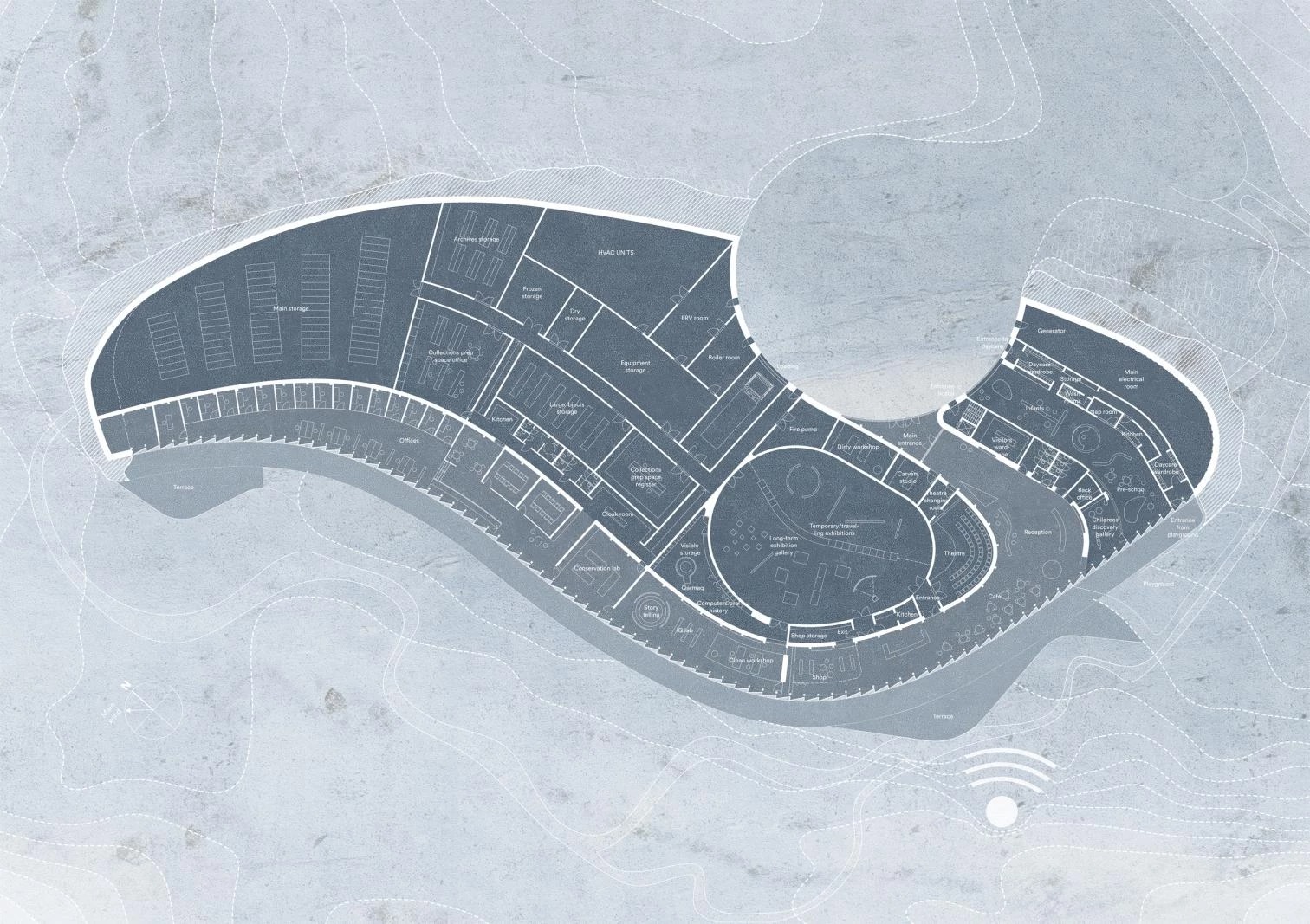
Mandrup, Dorte. “Nunavut Inuit Heritage Centre Floor Plan.” 2023, Iqaluit, Nunavut.
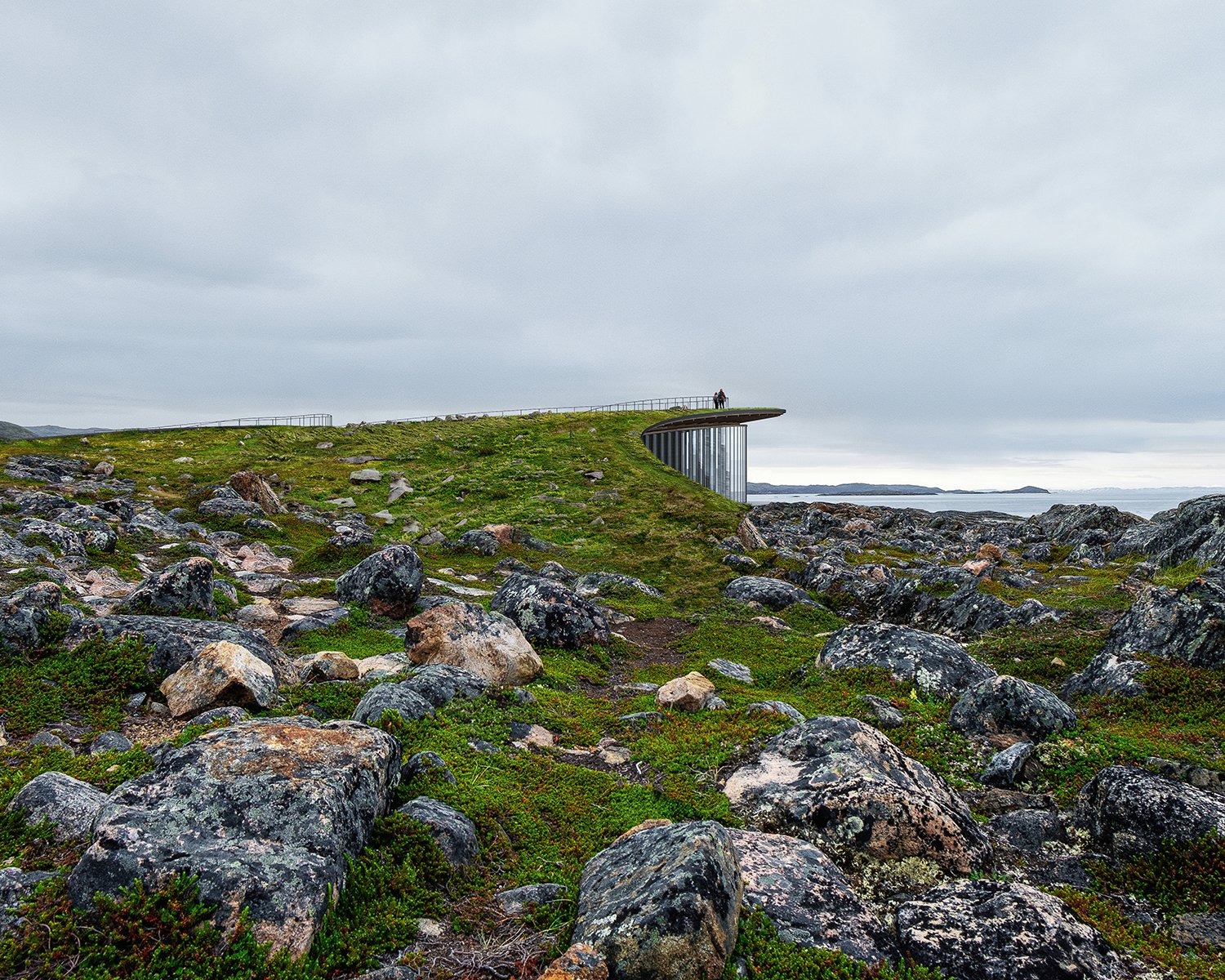
Mandrup, Dorte. “Nunavut Inuit Heritage Centre Outside View in Summer.” 2023, Iqaluit, Nunavut.
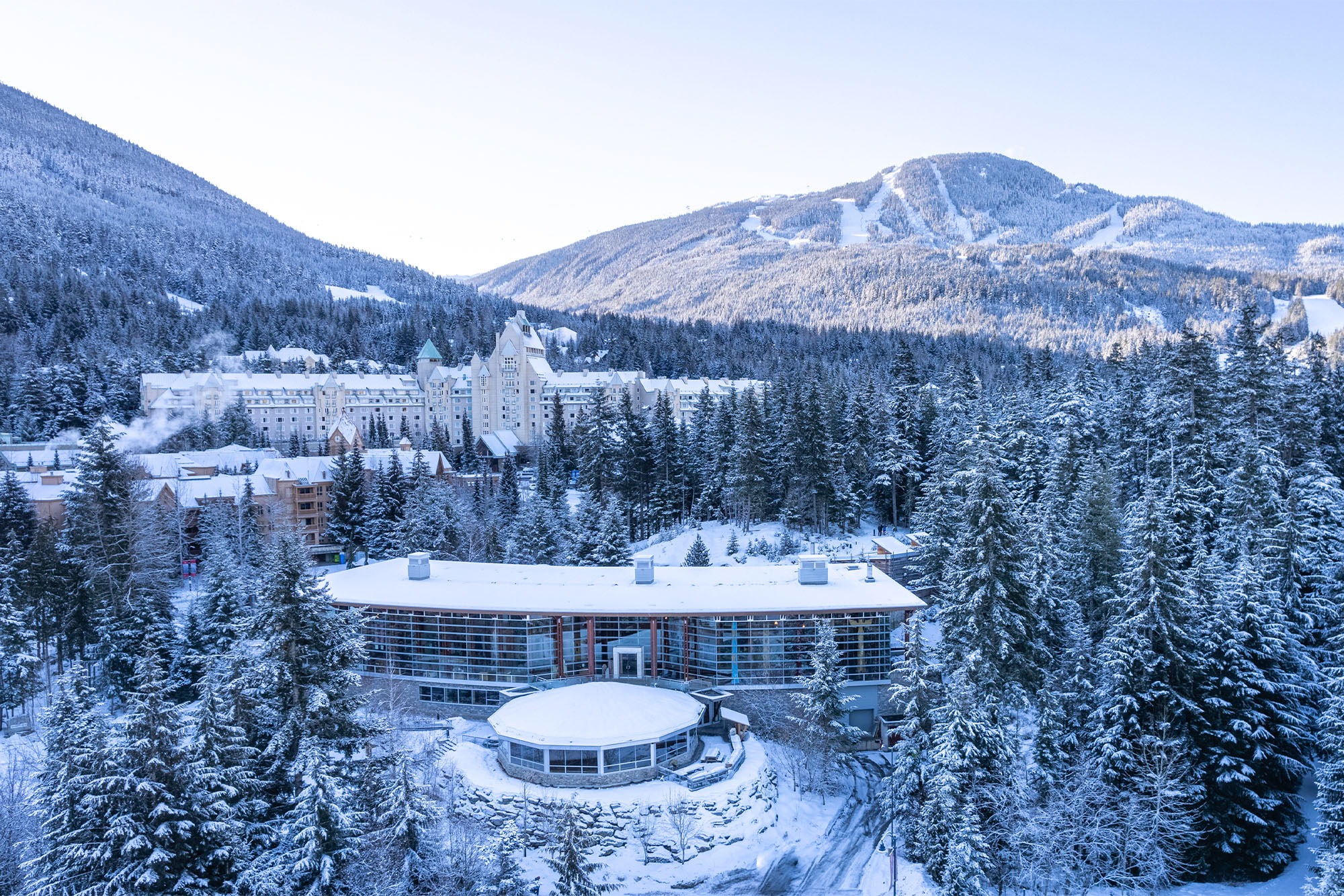
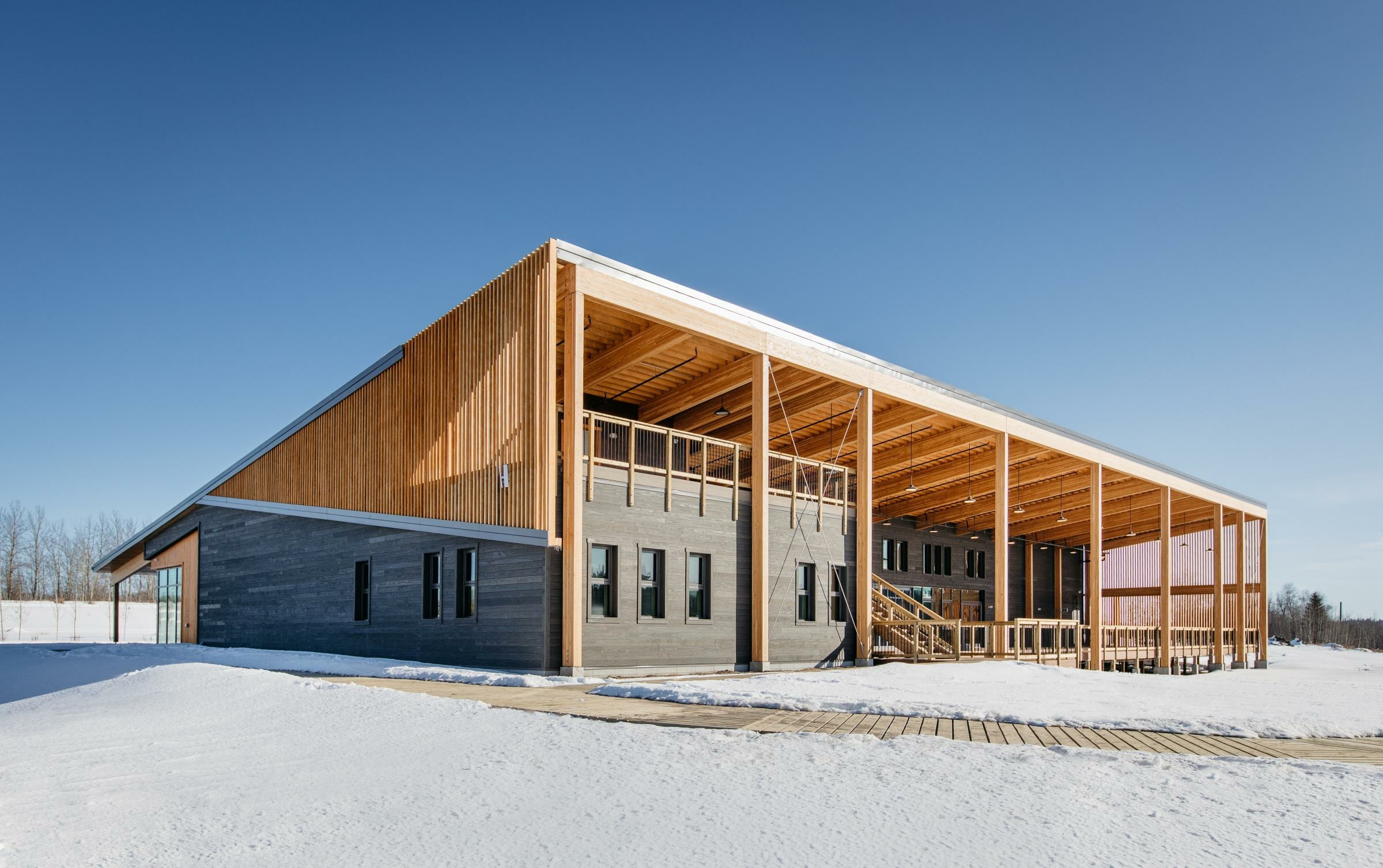
Colours and textures, as a result of material use, can often replicate nature and the Aboriginal environment in abstract ways. This allows the body to further acknowledge the land’s traditional ownership and the way of life that blends the body and the environment together. One way to display Traditional Knowledge in architectural design is through the use of Aboriginal-inspired structures, colours that reflect the natural environment, and exposed materials that reflect the indigenous environment in which the structures are built. Although contemporary western architecture often employs variations on the international style, which features grey-tone colours, modern materials, and designs that contrast the natural environment, contemporary Aboriginal architecture commonly uses colours and materials that bind together traditional, western, and biophilic knowledge. In British Columbia, the Squamish Lil’Wat Cultural Centre acts as a doorway to the forest, and its large glass walls allow the structure to both reflect the forest surrounding the area and resemble the ice that naturally coats the local mountains in winter. This multifaceted use of the glass walls allows the Aboriginal centre to function as a doorway between nature and human spaces through the use of biophilic designs that employ materials and colours to mimic the nature that the Squamish and Lil’Wat communities have long had a relationship with. Although these uses of materials and colours that mimic nature may not always be historically accurate, as these community centres exist in the present and enable the body to connect to nature in the modern context, they are still significant in fostering a connection between the built environment and the natural world. Aboriginal structures incorporate visual elements that evoke the indigenous environment, resulting in decolonial designs that utilise traditional knowledge to create contemporary structures.
In Nature
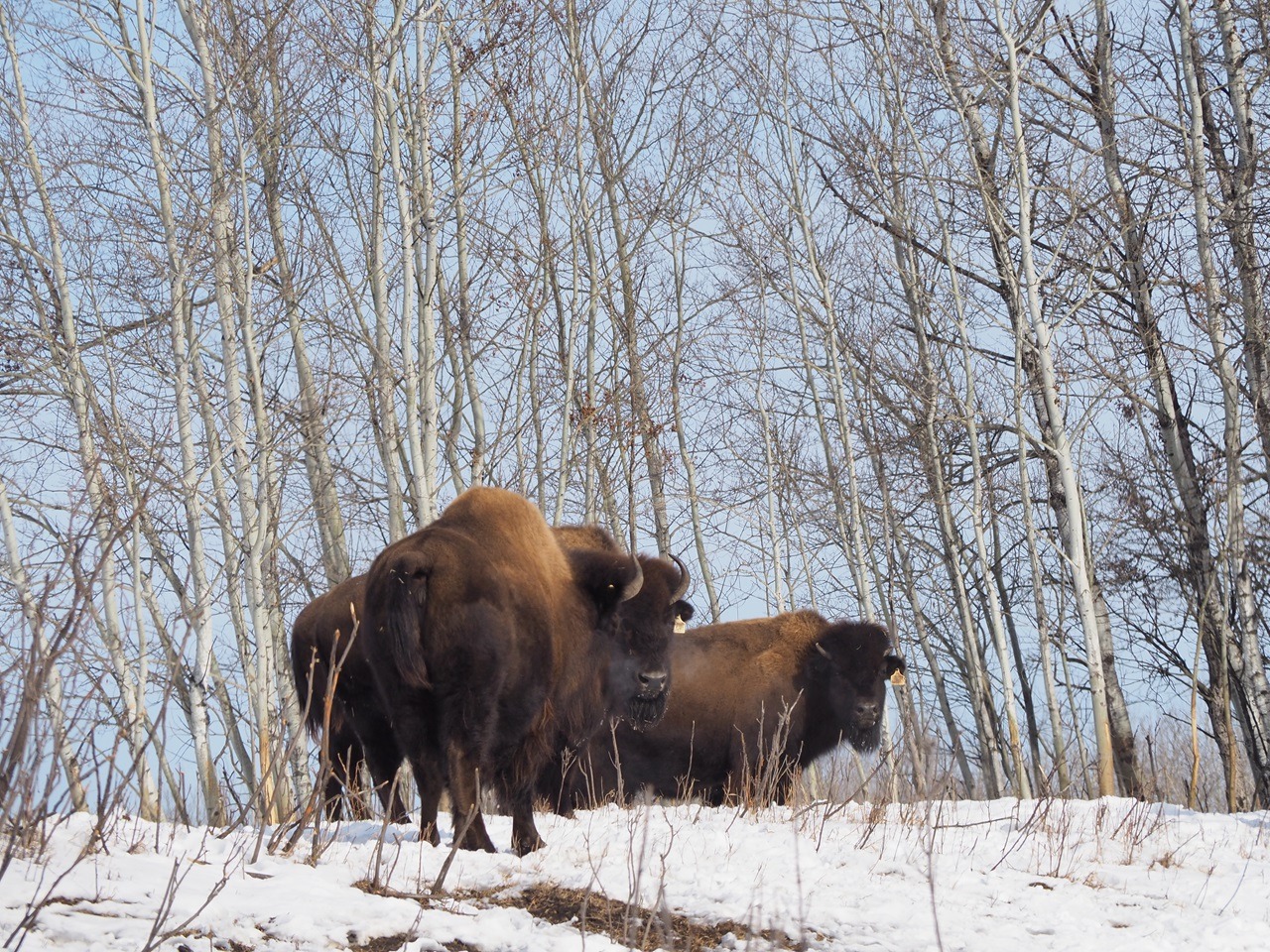
Merchant, Malik. “Plains Bison at the Métis Crossing Wildlife Park,” 2024, Smoky Lake, Alberta
Aboriginal communities are deeply connected to the plants and animals in their environments, and they use this knowledge to showcase the wonders of nature and emphasise it for the body. For example, at the Métis centre, the bison is a symbol of the community, and the Totem Poles at the Squamish Lil’Wat centre and the interior artworks at the High Arctic centre also showcase the beauty of nature. In contrast, colonial architectural trends tend to focus on plants and animals from a global perspective rather than from an indigenous and local one. However, Aboriginal communities have deep connections to specific animals, especially in relation to seasons. For Métis communities, material culture places an emphasis on traditional ways of existing with nature. This use of Aboriginal knowledge is not limited to physical materials, and animals are often used as part of the knowledge transfer process. At the Métis Crossing Gathering Centre, for example, bison is used to showcase the beauty of traditional methods of living, and the community centre has dedicated land space to protect and care for these animals. Caring for these animals in all seasons connects the body with the body of the animals and reminds them both of the beauty of traditional methods of living. In the Arctic, a variety of animals, such as walruses, seals, whales, geese, fish, polar bears, and caribou, are of cultural significance for the Inuit people. The resilience of these animals, particularly the whale, is celebrated through the artwork that adorns the floors and walls of the Canadian High Arctic Research Station.
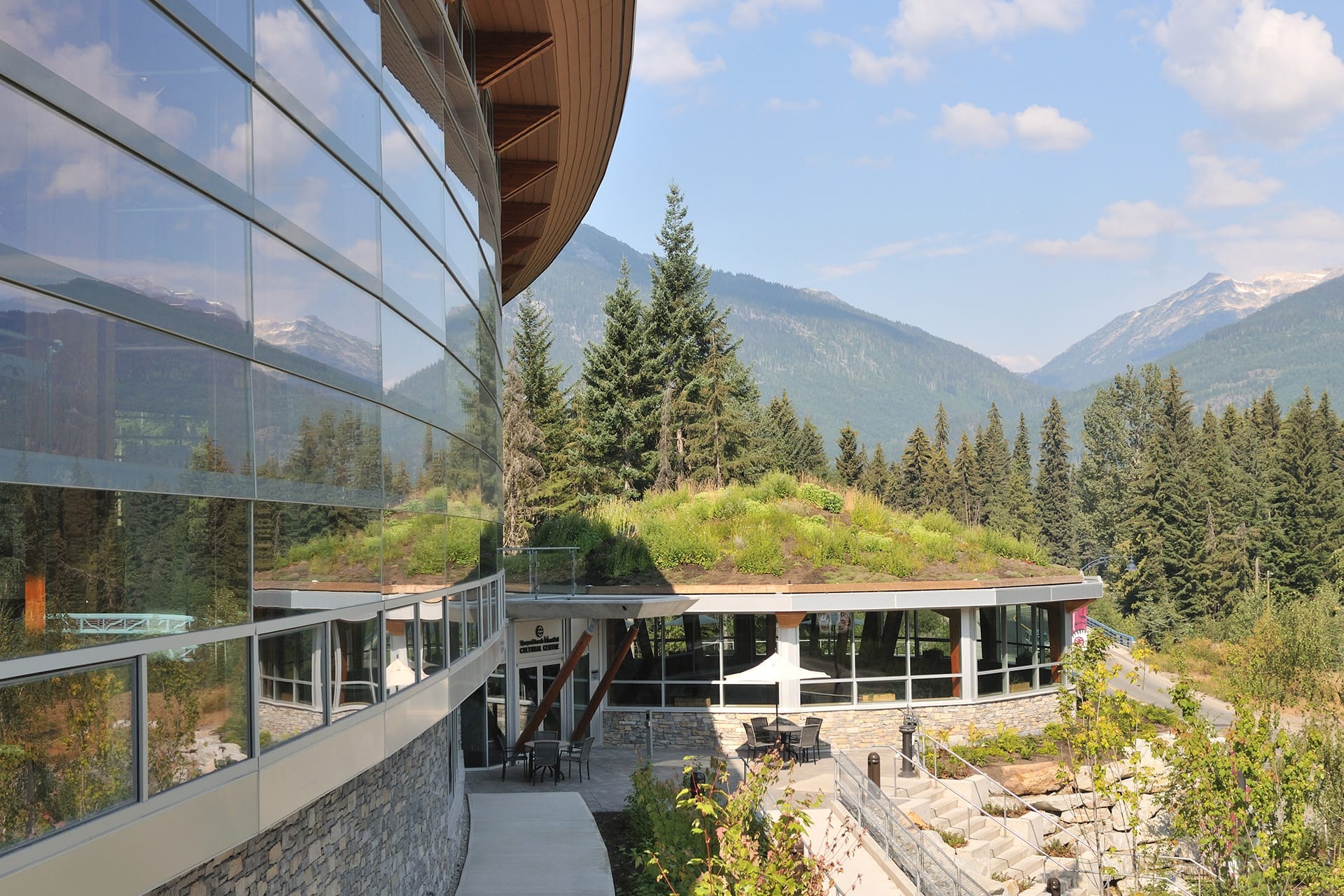
Ratio Architectural Firm. “Squamish Lil’Wat Cultural Centre’s Iskten Hall Grass Roof.” 2008, Whistler, BC.
The architecture of colonial and western societies often separates individuals from the natural environment or incorporates artificial or invasive natural elements that further distance people from indigenous plant life. This approach is not supported by the principles of Aboriginal design, as it shows a lack of respect for the environment and the traditional knowledge that has sustained these communities for centuries. Historically, pit houses with earthen roofs have been used in the Lil’wat communities of Western Canada. Accordingly, the Squamish Lil’Wat Cultural Centre features a pit house-inspired structure with an earthen roof, which not only provides a more structurally sound roof but also incorporates local greenery and traditional knowledge. In a similar vein, the Inuit Heritage Centre in Nunavut has an earthen roof that covers the entire structure, again incorporating local foliage and traditional knowledge in its design. By integrating natural elements, such as grass roofs, into the design, both structures allow individuals to remember and appreciate the environment in which they have been built, blending nature into the structures. Additionally, the Squamish Lil’Wat Cultural Centre uses animal sculptures, or totem poles, which are attached to wooden spars made from intact tree trunks. These totem poles, which are similar to those used in traditional long houses, represent a connection between the earth and the sky, emphasising the interconnectedness of nature. Animals and plants were often embellished in parts of traditional Aboriginal buildings, as they hold a significant place in nature and symbolise life. As the Squamish Lil’Wat Centre is modelled after traditional longhouses, it can be inferred that the inclusion of animal sculptures was deliberately incorporated to reflect a decolonial aesthetic. Indeed, the integration of animals and plants in all such structures exemplifies the Aboriginal style’s aspiration to incorporate indigenous knowledge and distance itself from colonial architectural designs, which seek to separate Aboriginal communities from nature.
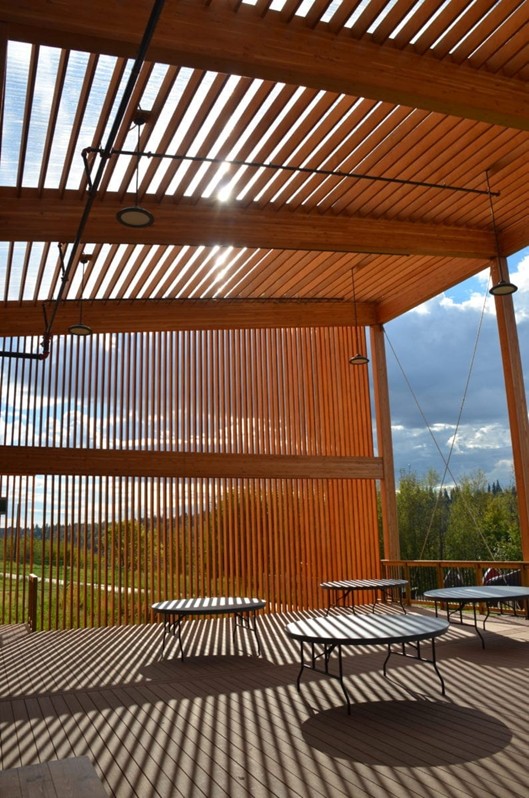
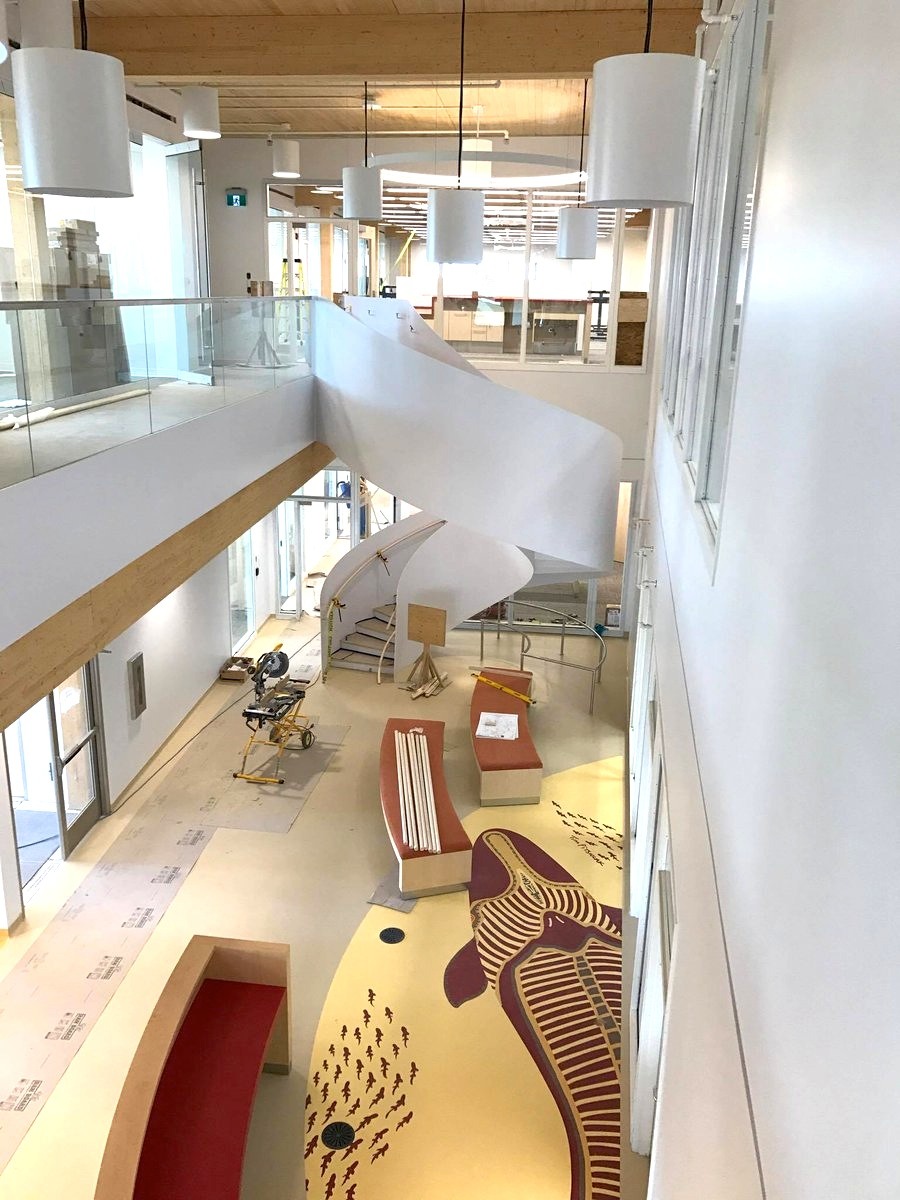
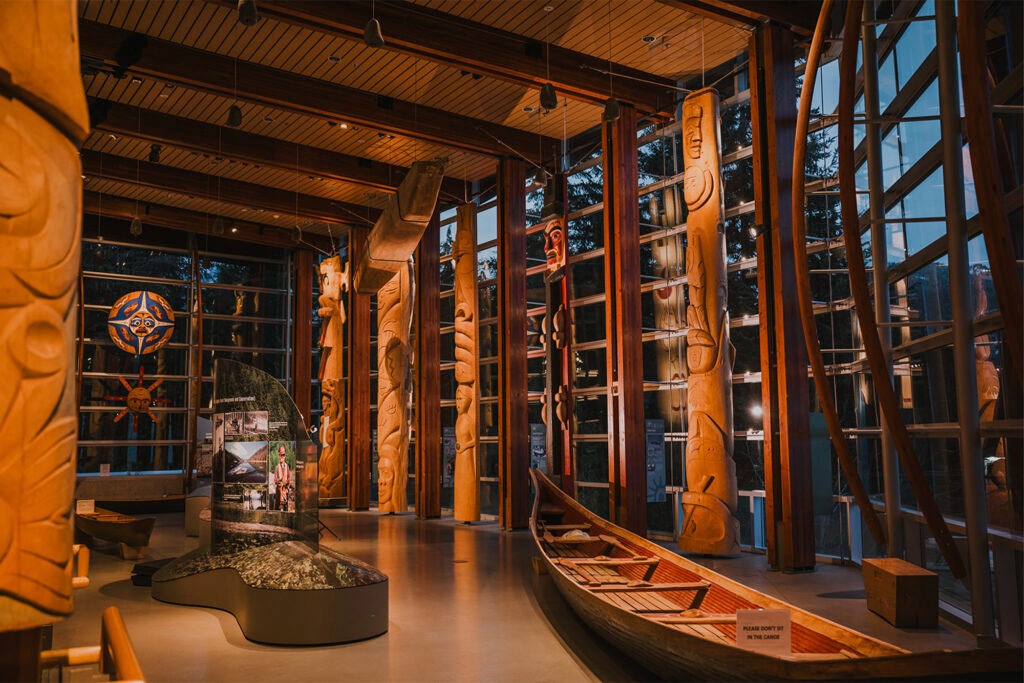
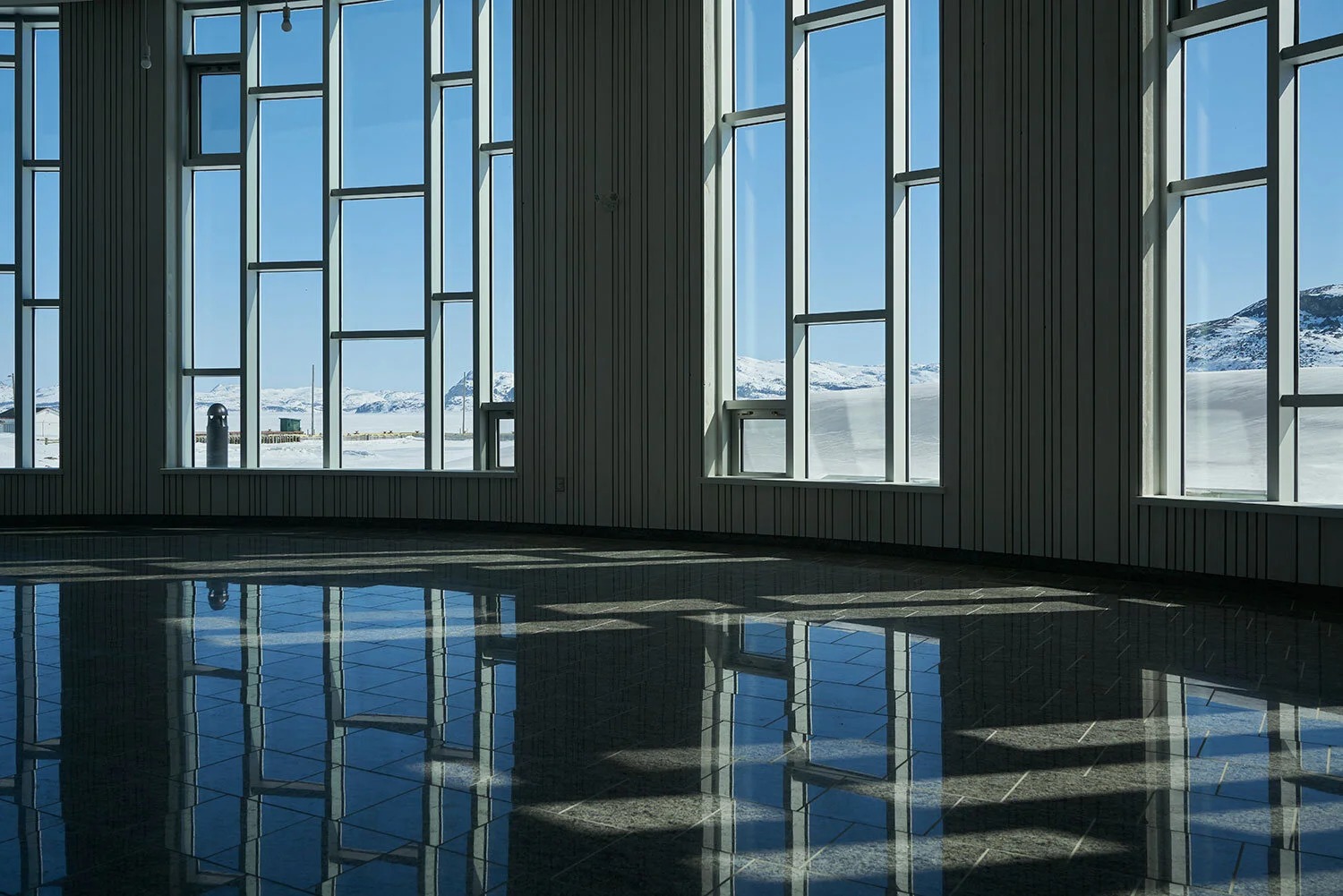
From Left to Right: Sanders Studio. “Illusuak Cultural Centre Inside Window View.” 2018, Nain, Labrador; Tiffany Shaw-Collinge. “Métis Crossing Gathering Centre, Covered Outdoor Space”; EVOQ Architects. “Inside Hallway at the Canadian High Arctic Research Station”; Ratio Architectural Firm. “Squamish Lil’Wat Cultural Centre’s Great Hall at Night.”
The integration of natural elements is a common feature of many Aboriginal postcolonial centres, which emphasise the importance of the environment and the need for the body to exist in harmony with nature. This is achieved by using slotted wood walls that allow wind, sunlight, snow, and other natural elements to touch the body while still providing some level of shelter. These centres often include spaces for learning about the local environment, which also serves to reinforce the connection between the body and nature. The Métis Crossing Gathering Centre is a prime example of this approach, with its slotted roof design creating a space that is both covered and exposed to the elements, ensuring that the body remains connected to the environment that has long protected it. Unlike colonial architecture, which tends to view winter as a harsh and unsafe season to be sheltered from, Aboriginal cultures see winter as a fundamental part of the cycle of seasons. Therefore, the slotted roof of the Métis Cross community centre serves as a powerful reminder of the importance of embracing and accepting the natural world, rather than trying to shut it out. The use of design features inspired by local flora and fauna in community centres embodies a crucial aspect of Aboriginal thought, which posits an inextricable link between nature and the human body. This connection is particularly significant for the Inuit, who have a long-standing tradition of knowledge sharing called the Inuit Qaujimajatuqangit (IQ). To facilitate this practice, the Canadian High Arctic Research Station has partitioned specific areas within its interior for community members to teach and learn. Furthermore, the station itself serves as a hub for environmental research and the knowledge generated is disseminated within the community, perpetuating the IQ tradition.
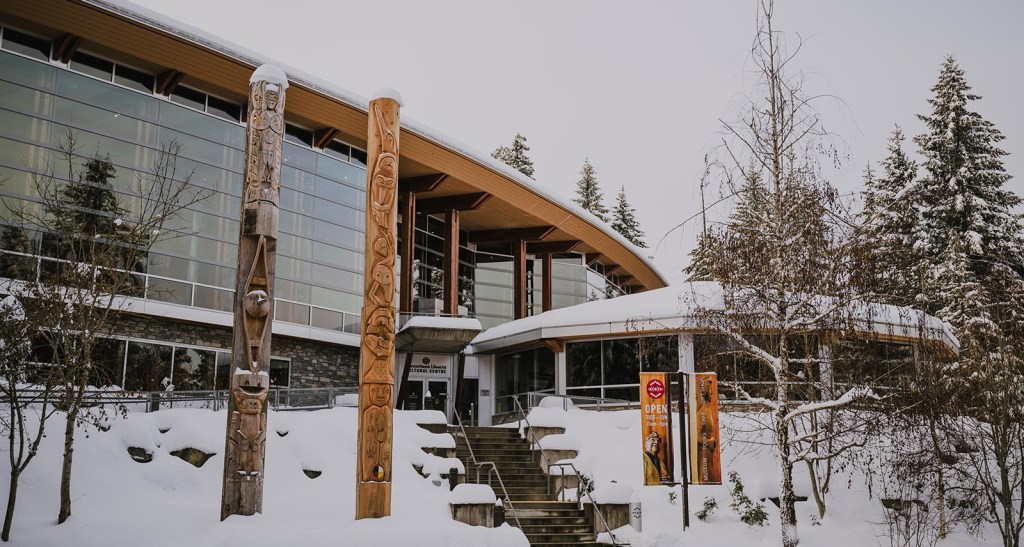
Ratio Architectural Firm. “Squamish Lil’Wat Cultural Centre Entrance.”
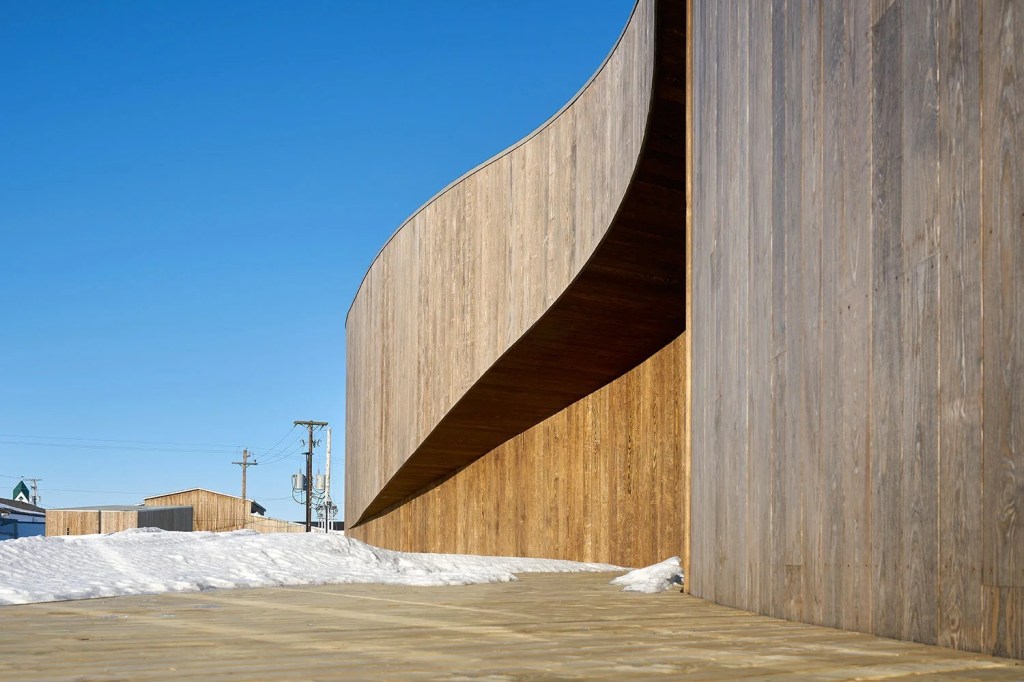
Sanders Studio. “Illusuak Cultural Centre Entrance.”
The incorporation of shapes that mirror the surrounding environment allows buildings to blend seamlessly into nature and enables individuals to feel a sense of connection with the landscape, rather than opposition. This is exemplified by the adoption of curved, round shapes that emulate mounds of snow or earth, vertical wooden structures that resemble trees in a forest, and square-geometric shapes with angled elements that evoke the image of an iceberg in water. For community centres, the choice of shapes is often influenced by the cultural values and traditions that each community wishes to symbolise. In the case of Arctic communities, icebergs and sea ice are of particular importance, as they have historically served as traditional hunting grounds and are rich in knowledge about ice formations. As the contemporary world experiences rising temperatures, it becomes increasingly crucial that Inuit, Inuvialuit, and Inu peoples respect and protect the ice. This notion can be applied to the analysis of the Canadian High Arctic Research Station’s shape, which is designed to resemble the jagged and multilayered appearance of sea ice. This shape serves as a reminder of the structure’s objective of safeguarding the land as well as the natural environment.
Architecture & the Body
Biophilic design, which incorporates open spaces and natural elements, is believed to promote relaxation and healing in the body. Also in Aboriginal architecture, open-concept designs have been employed for centuries due to their ability to efficiently use the natural environment as a space without obstructing the body from it. These traditional structures typically featured elements that evoked nature through light, touch, and natural colour tones. The Aboriginal characteristics in such spaces were designed to address the Aboriginal needs, the Aboriginal body, and the traditional ideology that connected both the environment and the community. These structures were often temporary, allowing them to adapt to changes in nature over time. Although contemporary Aboriginal community centres use more permanent materials and designs, they continue to be open concept and emulate nature on the interior. This arrangement allows the body to move freely between indoor and outdoor spaces, creates outdoor spaces on the inside, and facilitates a seamless transition between the two spaces for the eye.
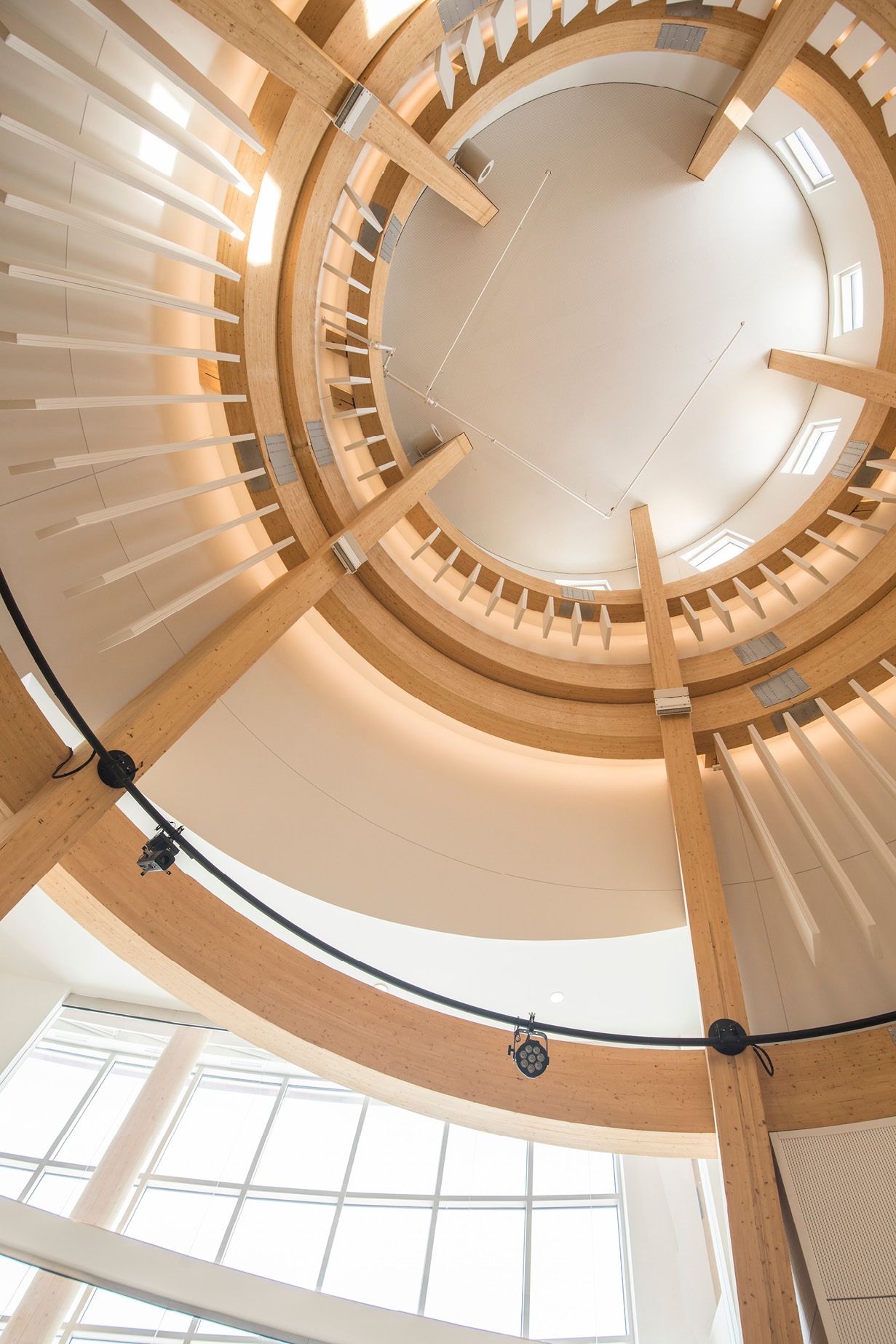
EVOQ Architects. “Inside Gathering Space at the Canadian High Arctic Research Station.”
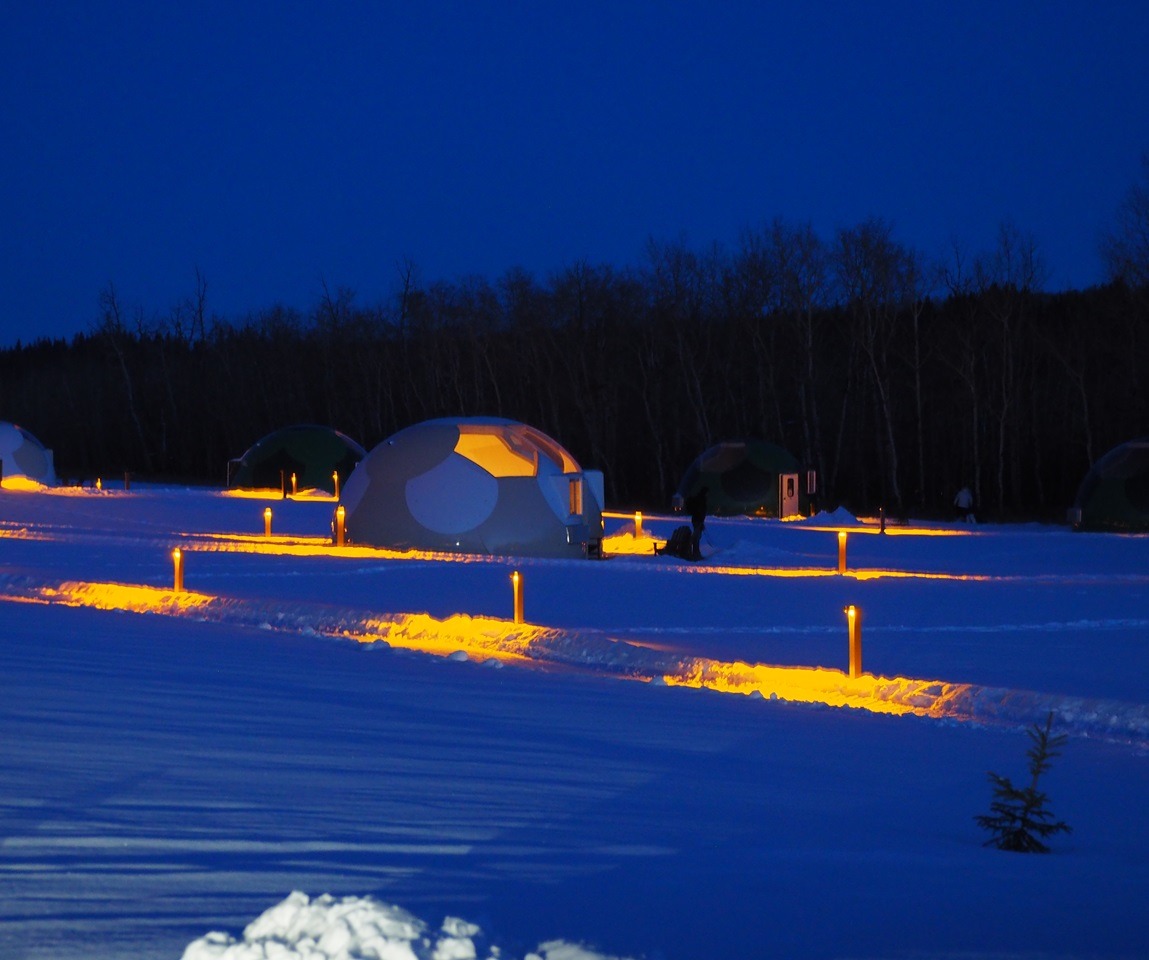
Tiffany Shaw-Collinge. “Métis Crossing Gathering Centre, Outdoor Sleeping Pods at Night.”
Aboriginal characteristics extend beyond visually distinctive elements to encompass the way in which the body interacts with the structure and the natural environment. In this context, indigenous knowledge emphasises the need for spaces that facilitate movement between areas in all conditions, open concept designs that accommodate Indigenous activities, and the use of curves that mirror natural paths. These characteristics enable the creation of structures that harmonise the body and nature by employing Aboriginal knowledge that aligns with the body’s movement on the land. Open-concept architecture is not exclusive to Aboriginal designs, and numerous contemporary Western architects incorporate open spaces into their structures. However, what distinguishes these community centres as postcolonial in their designs is their use of open spaces between the interior and exterior to connect Aboriginal communities with their ancestral land. In the case of Métis architectural design, David T. Fortin notes that it is common to see spaces as open, multipurpose areas similar to the openness of the outdoors where the body can move around, and diverse activities can be performed in the same space. At the Métis Crossing Gathering Centre, this idea is exemplified through the generous open spaces where snowshoe hikes frequently occur during winter. Moreover, Inuit communities have long held the belief that it is detrimental to one’s health to be disconnected from nature, especially during the colder months. To counteract this, they have constructed structures such as the Inuit Heritage Centre, which incorporates Traditional Knowledge and open concept designs to allow the body to traverse on top and around the structure. According to Heyes and Dowsley, Inuit architecture is deeply rooted in environmental knowledge and serves to enhance the Inuit’s understanding of the land, including the traditional uses of open spaces that blend the indoor and outdoor environments together.
Windows, particularly those that span entire walls, are a characteristic commonly found in contemporary Aboriginal community buildings. These windows offer a seamless view between indoor and outdoor spaces, creating a harmonious environment that blends nature and shelter. The aesthetics and designs of these structures often draw inspiration from Traditional Knowledge and the way the body should interact with its environment. They create indoor spaces that resemble the natural environment, with colours, lighting, and tall windows that mimic the outdoors. These features help to blend the body and nature together, constantly reminding the viewer of the openness of nature. While colonial architecture also employs large windows, natural colours, and distinct lighting, it is the way that Aboriginal structures use these elements to shape the body’s interaction with nature that sets them apart. The colours and materials used in Aboriginal structures often resemble native plants and animals, emphasising the connection between the body and nature and allowing viewers to feel a part of it rather than separated from it. Art historian Wanda Dalla Costa notes that local materials can symbolise the surrounding environment in Canadian Aboriginal architecture. This concept is evident in structures like the Illusuak Cultural Centre, where the white interior reflects the snow that surrounds the building during the year, blending the interior with the snow outside. Additionally, large windows contribute to the utilisation of open concept designs by facilitating unobstructed visual lines between the interior and exterior, thus placing the outdoor perspective within the interior. This arrangement enables the body to feel as though it is part of the outside space while remaining in either environment, creating an overall design that merges the body and nature. Employing tall windows that serve as walls, as exemplified by the Inuit Heritage Centre, enables light to penetrate the barrier separating the internal and external environments of the body. Windows serve as a potent instrument for space creation and assist in incorporating natural elements in a visual manner.
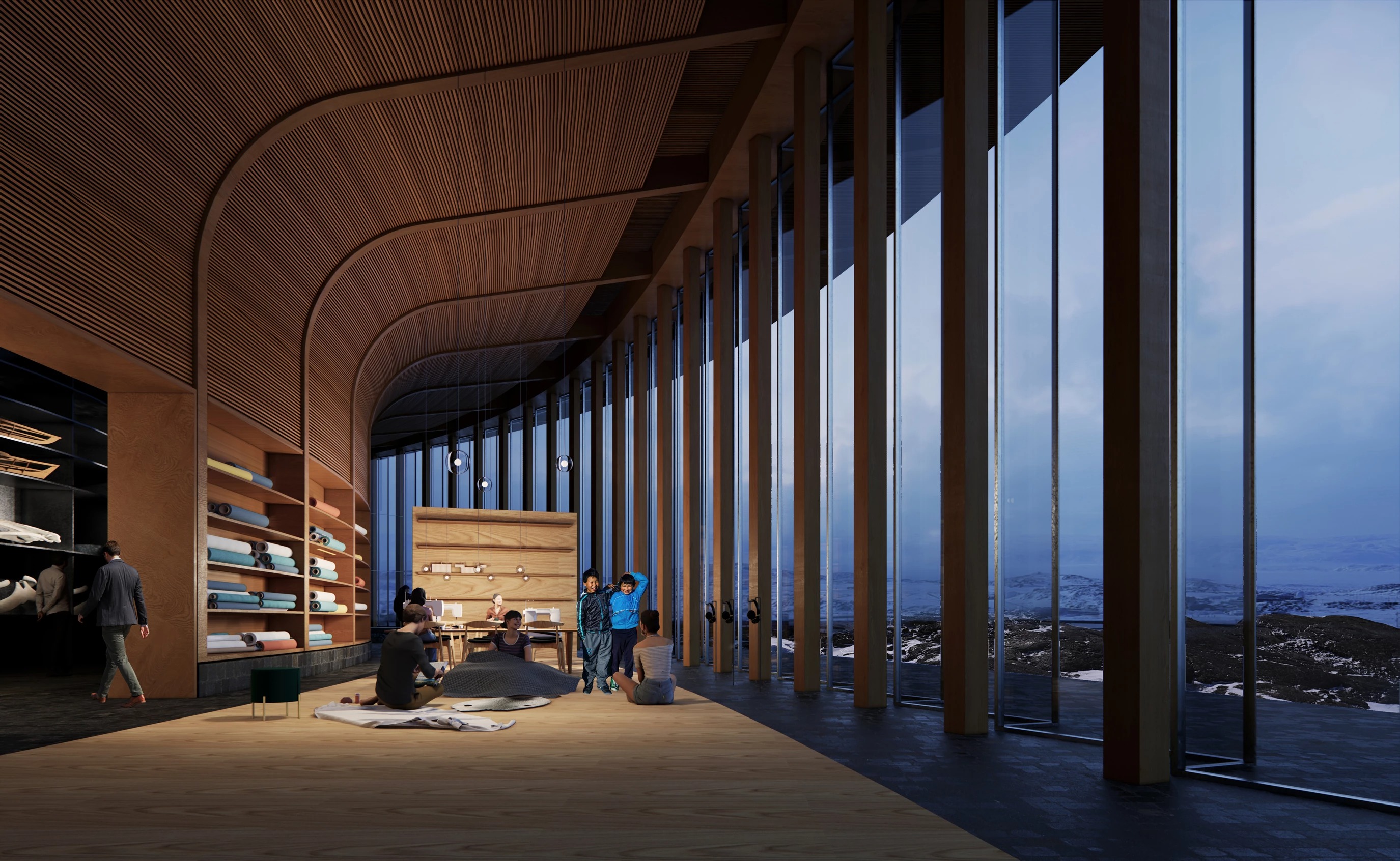
Mandrup, Dorte. “Nunavut Inuit Heritage Centre Dirty Workshop Inside.”
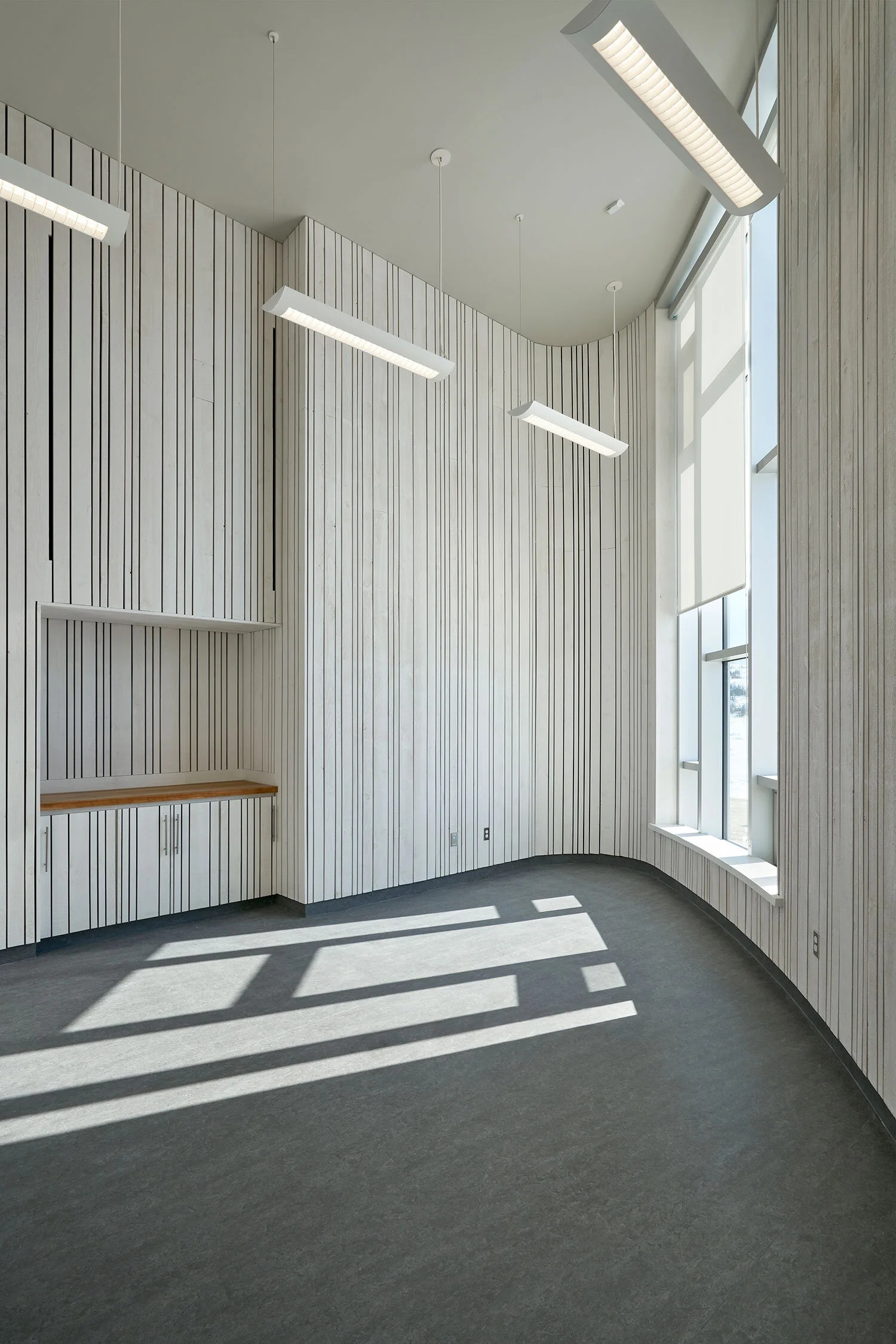
Sanders Studio. “Illusuak Cultural Centre Inside Wall Design.”
Lighting plays an important role in architectural design, and recently Aboriginal community centres have started to incorporate light sources inspired by the natural surroundings that the structures themselves represent. Many parts of Canada located in the cold climate are fortunate enough to witness the Aurora Borealis, also known as the Northern Lights, a natural phenomenon that has traditionally and naturally illuminated the environment. The Inuit Heritage Centre has recreated the appearance of the Northern Lights with its window wall, using warm two-tone lights that resemble the two-tone nature of the Aurora Borealis. In contrast, the large windows at the Illusuak Cultural Centre do not significantly light up the outside space, allowing the community to continue to see the stars in the night sky instead of mimicking them. Additionally, the windows of the Illusuak Cultural Centre incorporate a birch tree design that is imprinted on the walls through sunlight. This use of light through windows to incorporate designs inspired by nature allows the body to feel as though it is outside while still being indoors. The Métis Crossing Gathering Centre also utilises natural light in its slotted wood walls to mimic the slotted lighting effect often experienced in the dense forests of Canada. The way sunlight hits the body is channelled through the slots in the wood, allowing for a controlled amount of warm light that does not overwhelm the body.
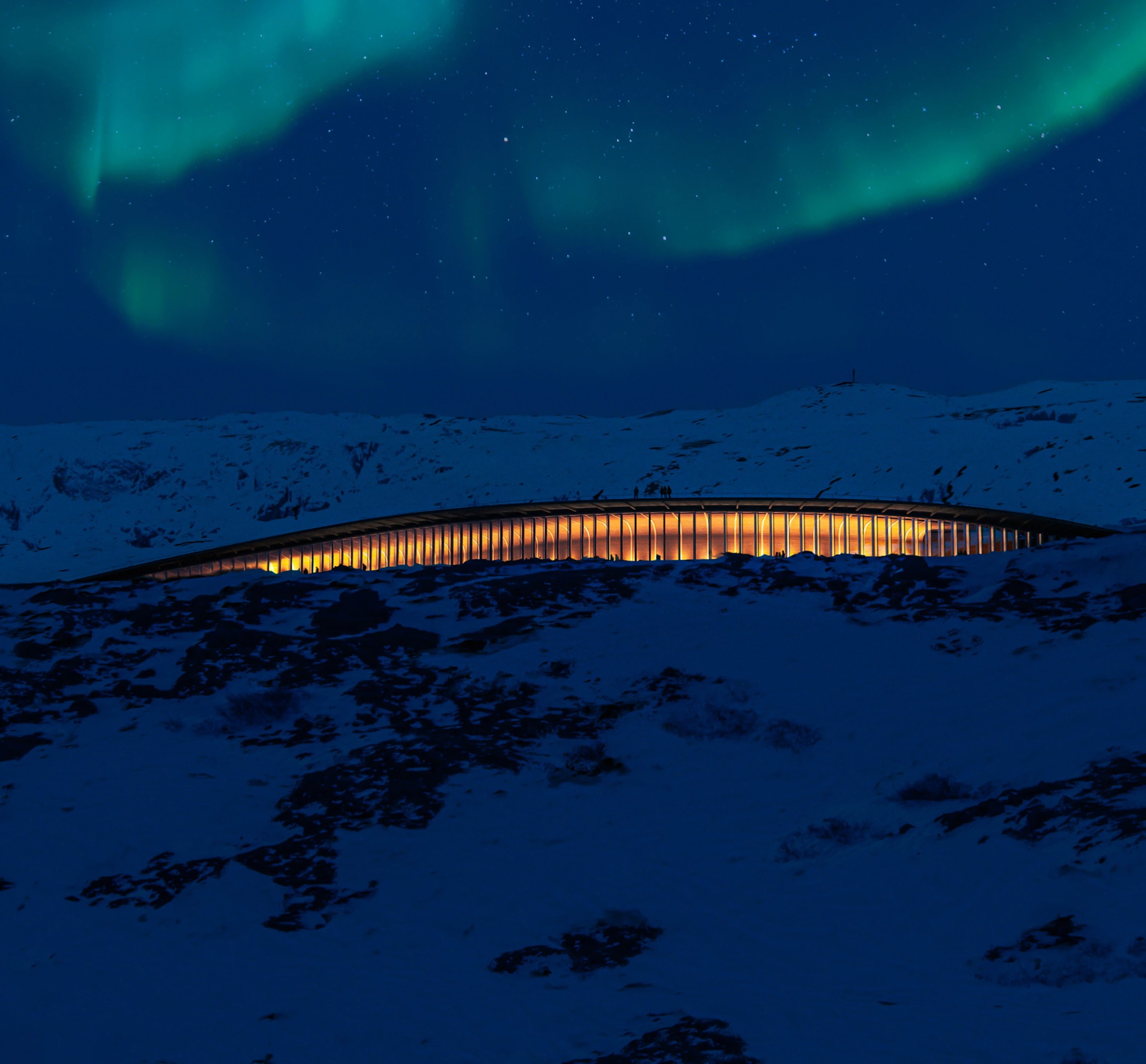
Mandrup, Dorte. “Nunavut Inuit Heritage Centre Outside View at Night.”
Conclusion
Aboriginal communities believe that the body should be allowed to traverse nature regardless of season, as opposed to Western architecture, which often involves the creation of underground tunnels and connected building interiors. According to Aboriginal communities, embracing nature in the cold is an important part of their culture, similar to how the winter weather has become an integral part of the Canadian identity as well. However, colonialism has led to the casting aside of Traditional Knowledge associated with the appreciation of winter by many contemporary Aboriginal communities. In recent decades, these communities have sought to incorporate their knowledge into modern architectural designs as a means of blending tradition with the present, and nature with structures. This emphasis on nature allows the body to recognise and respect the environment that has long been associated with each Aboriginal community. Many of these sites serve as learning spaces, through hands-on teaching methods, research practices, and activity spaces that allow the Aboriginal body to move in nature in accordance with traditional practices. These structures use natural elements, shapes, colours, materials, open spaces, and indigenous life to highlight the importance of preserving Traditional Knowledge and embracing the natural world. By blending nature and the body, people can become more aware of the environments in which they live, the animals they coexist with, and the impact they have on the land. Community structures across Canada are showcasing the power of Aboriginal knowledge in creating a new idea for biophilic designs that prevent separation from the body with nature.
More on the Topic…
Sarah Noal. Cool Architecture: Designing for Cold Climates. Mulgrave, Vic.: Images Pub, 2003.
Elsa Lam and Hudson Graham Livesey. Canadian Modern Architecture: 1967 to Present 1. Princeton Architectural Press, 2019.
Peter Hemmersam. Making the Arctic City: The History and Future of Urbanism in the Circumpolar North. Bloomsbury Publishing, 2021.
Stephen R. Kellert. Nature by Design: The Practice of Biophilic Design. Yale University Press, 2018.
Flavie Deveaux
Bibliography: Baptist, Karen Wilson. “9 Wide Open Space: Towards a Phenomenology for Prairie Landscape Architecture.” In Innate Terrain: Canadian Landscape Architecture. Toronto: University of Toronto Press (2022): 223-252; Dalla Costa, Wanda. “Metrics and Margins: Envisioning Frameworks in Indigenous Architecture in Canada.” In The Handbook of Contemporary Indigenous Architecture. Singapore: Springer (2018): 193-221; “Dorte Mandrup Reveals Design For Inuit Heritage Centre Informed By ‘Patterns Formed In Snowdrifts’.” World Architecture; Fahlgren, Grant. “1 Collaboration with the Keepers of Traditional Knowledge.” In Innate Terrain: Canadian Landscape Architecture. Toronto: University of Toronto Press (2022): 13-42; Fortin, David T. “10 Mixing It Up: Métis Design and Material Culture in the Canadian Conscious.” In The Handbook of Contemporary Indigenous Architecture. Singapore: Springer (2018): 253-282; Hemmersam, Peter. Making the Arctic City: The History and Future of Urbanism in the Circumpolar North. London: Bloomsbury Publishing, 2021; Hénault, Odile. “First Nations Architecture: A Long Journey Forward.” In Canadian Modern Architecture: 1967 to Present. First edition. Edited by Lam, Elsa, and Graham Livesey, Hudson, NY: Princeton Architectural Press (2019): 146-173; Heyes, Scott A. “Embracing Indigenous Knowledge System: The Spiritual Dimensions of Place.” In SiteLINES: A Journal of Place 16, no. 1 (2020): 3-7; Heyes, Scott A, and Martha Dowsley. “Practices and Processes of Placemaking in Inuit Nunangat (The Canadian Arctic).” In The Handbook of Contemporary Indigenous Architecture. Singapore: Springer (2018): 283-299; George, Jane. “Canadian High Arctic Research Station remains a big unknown to many.” Nunatsiaq News. October 30th 2019; Gowans, Alan. “Canada’s Urban History in Architecture, Part Three.” In Urban History Review 12, 1 (1983): 45-65; Grosset, Chris and Marla Limousin. “Chapter 4 Landscapes of Culture: Inuit Traditional Knowledge Applied.” In Innate Terrain: Canadian Landscape Architecture. Toronto: University of Toronto Press (2022): 91-112; Kapelos, George Thomas. “The Architecture of Public Institutions.” In Canadian Modern Architecture: 1967 to Present. First edition. Edited by Lam, Elsa, and Graham Livesey, Hudson, NY: Princeton Architectural Press (2019): 62-110; Kellert, Stephen R. Nature by Design: The Practice of Biophilic Design. New Haven: Yale University Press, 2018; “Métis Crossing Gathering Centre.” Reimagine. Accessed April 2024; Mills, Edward and Harold D. Kalman. “Architectural History of Indigenous Peoples in Canada.” Edited by Michelle Filice, The Canadian Encyclopedia Publishing, November 2016; Morgensen, Scott Lauria. “Destabilizing the Settler Academy: The Decolonial Effects of Indigenous Methodologies.” In American Quarterly 64, no. 4 (2012): 805-808; Noal, Sarah. Cool Architecture: Designing for Cold Climates. Mulgrave, Vic.: Images Pub, 2003; Pressman, Norman, David W. Phillips, and Léo Zrudlo. “Canada.” In Cities Designed for Winter. Datutop. 12. Edited by Jorma Mänty and Norman Pressman. Helsinki: Building Book (1988): 33-110; Rutka, Jacob. “The Building: Labrador’s striking new cultural centre.” Maclean’s. March 2023 Issue; “Squamish Lil’Wat Cultural Centre.” Ratio. Accessed April 2024.
 Can I Tell You About That: A Blog About History & Art