
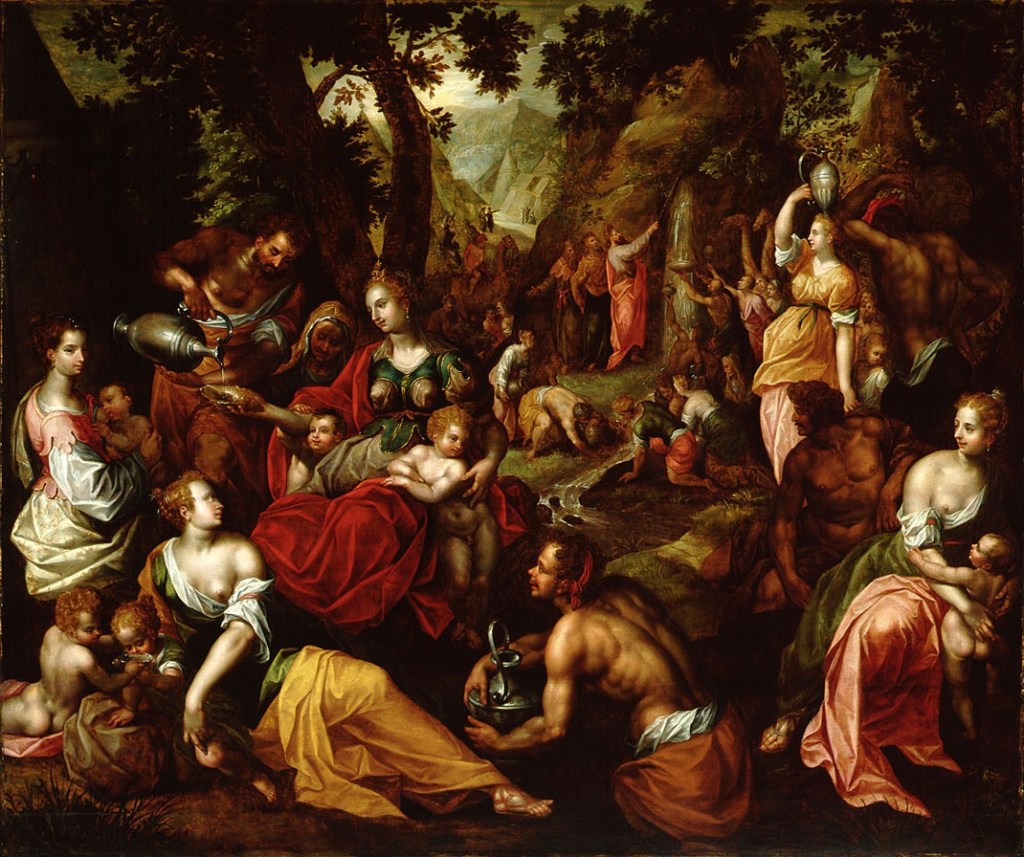
In the 16th and 17th centuries art world of the Northern Renaissance, styles developed to distinguish themselves from Catholic art in the South. New Protestant values aimed to de-idolize figures in art, turning the focus towards God and God alone. Many Netherlandish artists still took inspiration from Italian works of art, including ancient mythology and Roman sculpture. But the works of Italian artists were typically Catholic and did not appeal to Protestant audiences, who now favoured secular works of art. However, Hendrick de Clerck’s (1570-1630) Moses Striking the Rock (1610) defies this idea by creating a work of art that is both sacred and post-reformation in style. At a first glance, de Clerck’s Moses Striking the Rock feels very Catholic with its luxurious scene depicting the Old Testament story of Moses and the water spring. This painting shows a scene of people relaxing and drinking water, with fantastic fabrics and lush Italian greenery. Through further analysis though, Hendrick de Clerck’s Moses Striking the Rock shows how the artist was able to exemplify a post-reformation art style in a sacred work of art, seen in the formal characteristics, the theme of community, and the Biblical story as a tool for reflection.
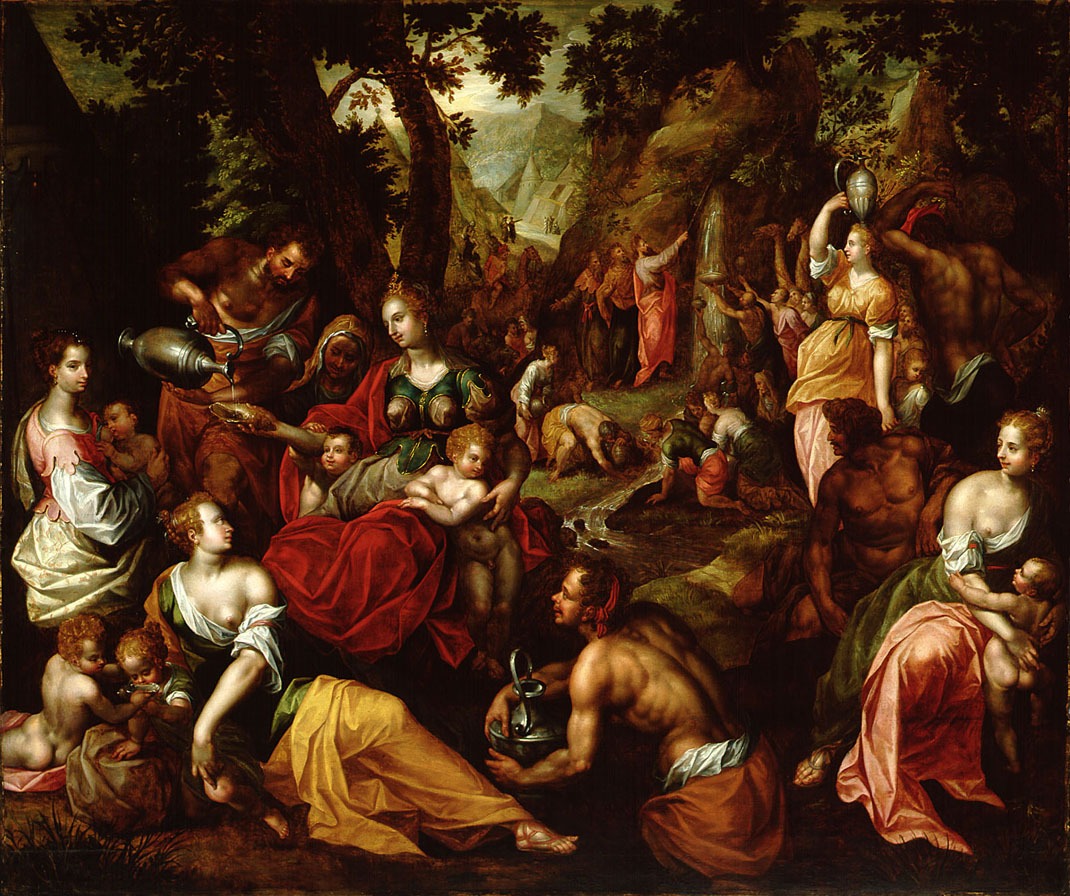
Hendrick de Clerck, Moses Striking the Rock (Tempera and oil on wood, 170 x 133 cm, 1610: Montreal Museum of Fine Arts, Montreal)
Space and Form
The post-reformation style that developed after 1517, was concerned with revelation, direct access to God, and salvation through faith alone. Sacred works from Reformation artists would depict “man as being in need of God’s grace”, with emphasis on the nourishment provided by God. In the story of the water springs from the rock, Moses turns to God for help and He provides the Israelites with the water they need to live. In de Clerck’s painting, the artist used rich greens and blues to emphasize the lushness of the environment, in order to allude to this post-reformation idea. The plants, which were likely inspired by Italian greenery, provides an atmosphere for the painting that is full of life, which is all being supported by God’s miracle of the water spring. Post-reformation art was also eager to depict the world more naturalistically. De Clerck uses colours from nature such as deep yellows, various brown tones, along with the greens to help create a more naturalistic space. The highlights of light blue on the water also help to emphasise its flow, drawing viewers’ attention to God’s miracle. The space around the water stream is filled with people and plants, displaying a thriving community inside the work of art.
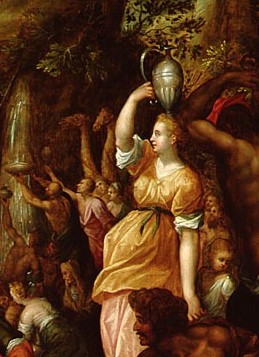
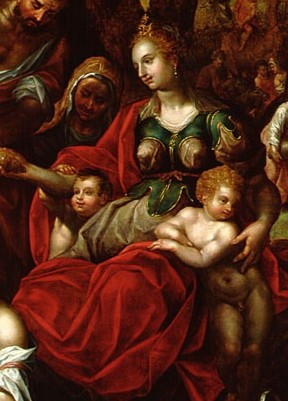
The shapes used in Moses Striking the Rock are reminiscent of Italian sculpture, with relaxed poses and exaggerated levels of greenery. This is likely influenced on de Clerck’s time in Italy, but does not mean this sacred work of art is Catholic in style. Rather, as secular art became more popular in the post-reformation world, antiquity became a popular influence on human form for these artists. De Clerck’s painting shows a female figure that stands on the right side of the piece holding a pitcher of water. This figure is displayed with a pose resembling that of many Ancient Roman sculptures. The central figure of the woman with two children by her side, has also been said to show an Italian influence, or the “influence of the marble Madonna (1501) [by the artist] Michelangelo”. The figures are less contorted too, and more linear in their poses, which gives the figures more naturalistic positions, thereby creating a greater sense of Protestantism in the final work. Furthermore, the figures in the foreground are depicted wearing clothes that are reminiscent of Greco-Roman styles, connecting the style to post-reformation art instead of luxurious Catholic works. The jugs of water used by the characters in this piece, are also clearly inspired by the shape of Ancient Roman jugs with their pair-shape bottom, tubular top, and long handle connected to the mouth of the container. Through these characteristics, de Clerck’s painting creates a pagan-antiquity setting for the Biblical story that was popular in Netherlandish paintings at this time. Although inspired by the Greco-Roman trend more so than the accurate setting for the story, it gives the piece a more secular feeling which draws the work away from becoming an icon piece. A decision to create a more secular version of the story, through de Clerck’s use of shapes, can be directly linked with Protestant works of art.
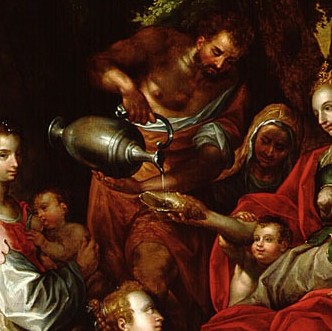
Martin Luther (1483-1546) believed images should not be idolized, but equally believed that some images with Biblical references could be used to help educate certain types of people. This reformation idea is seen in de Clerck’s work, with a telling of an Old Testament story that has an emphasis on community values instead of the praising of the Biblical character Moses. The image, which was likely done for a private home, shows no depictions of patrons praying to saints for salvation and no coat of arms to denote who commissioned the piece. In Protestantism, acts of patronage do not grant salvation, so a commission of this kind was meant more for personal reflection than anything else. In Luther’s 95 Theses, point number 68 says that “nevertheless, [treasures] are not to be compared with the grace of God and the compassion shown in the Cross”. This point emphasises how Protestantism perceives commissioned works of art as non-penitence for ones sins. De Clerck recognized this value when creating Moses Striking the Rock, as the artist brought the focus on God’s work as even Moses called to God for help rather than creating this miracle on his own in the story. This work of art remains sacred as it depicts the Old Testament scene, but creates a sense of de-idolization with its presentation of the story.
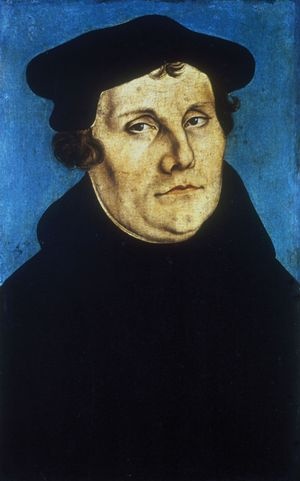
Lucas Cranach, Reformer Matin Luther (Oil on panel, 1529: The Uffizi, Florence)
The Biblical Story and contemporary Life
The story of Moses striking the rock focuses on a stream of water that quenches the thirst of the Israelites that followed Moses into the desert. The symbolism of the water itself is an un-idolized reference to community. Water is a symbol for life, and a well is a symbol for the life of a community. The Israelites drink from the water that God provided them to sustain life as a community. De Clerck uses the water to bring the characters of this piece together. In both the story and the painting, water exemplifies community values that were encouraged in Protestantism, which de Clerck is able to work with in order to create a sacred, post-reformation piece. In Christianity the “distribution of water [in this story] is a means of acknowledging livelihoods” which Moses Striking the Rock also tries to acknowledge with its theme of community. The water stream is located just off center but still a focal point of the piece, further acknowledging the symbolism that the water holds for the bonding of community as figures surround it. Community is a big part of Christianity, but without the head Church as the central image of that community in Protestantism, artists had to find other ways to exemplify the value of community. De Clerck’s piece is themed around this value since it is fundamental to sacred life in the post-reformation world. In Moses Striking the Rock, the symbol of water fills the void of symbolism and presents an unidolized community.
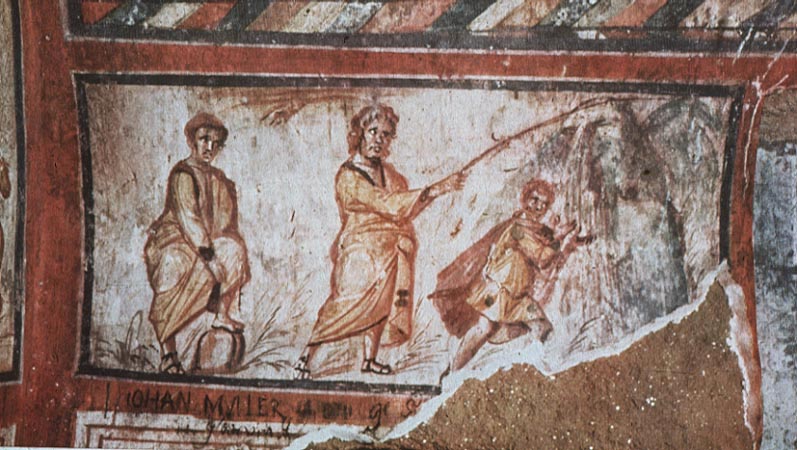
Moses Striking the Rock (Paint on stone, ca. 3rd century: Catacomb of Callistus, Rome)
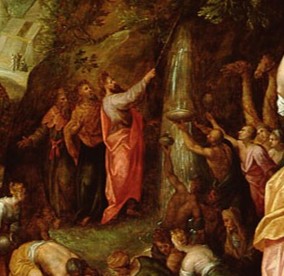
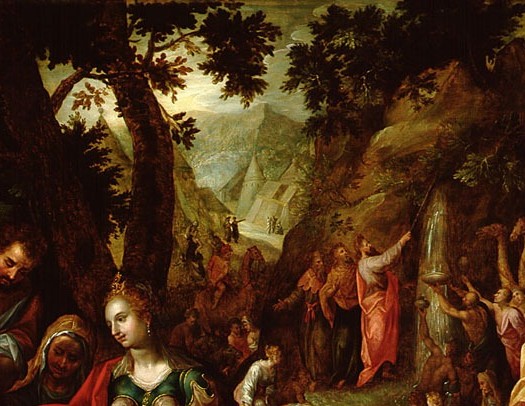
The space used by de Clerck in his sacred painting, also creates a stronger post-reformation style than a Catholic one. Moses Striking the Rock depicts figures in groups and a scene full of life. This is reminiscent of Luther’s idea towards the Eucharist, where everyone takes part in it as a fellowship, and where they are “‘made into a community by love’”. The figures are placed throughout the piece, but are painted in groups to emphasise the value of community. Luther saw everyone as apart of the Church because the Church is a community. The foreground is filled with figures in relaxed poses, which captures the viewer’s initial attention. De Clerck purposely used the absence of figures in a section of the foreground to create a frame for the main scene of the painting. Through this frame viewers see Moses striking the rock with the water stream taking up a larger amount of space than Moses’ character. This is to emphasize this miracle as God’s and not Moses, and to deter idolization of other figures. Behind these front figures, the rest of the painting is filled with even more figures and plants. Most of the painting’s space is filled with representations of thriving life, creating a greater sense of God’s miracle as the single source of live.
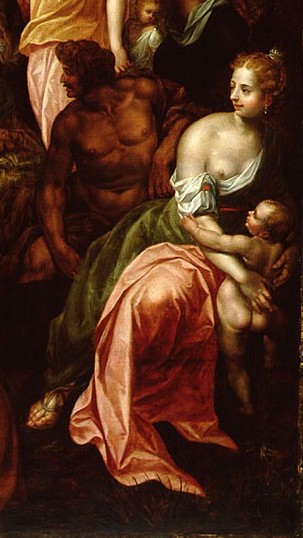
Breastfeeding became an important symbol for the bond within families and communities, and de Clerck’s piece shows several women’s breast as if they were just finished feeding a baby, and with one woman still in the process of feeding. De Clerck creates several depictions of a secular Madonna, for this piece is about a community full of family units. Despite the piece representing a general Christian image, de Clerck is able to exemplify Christian values without going against post-reformation views towards sacred images. Using community as a theme in this piece, Moses Striking the Rock is able to remain sacred while also not creating an image of idols.
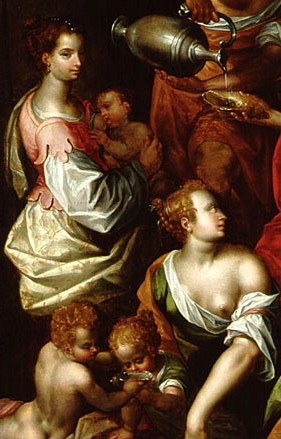
Community is a fundamental aspect of the Christian faith, with Augustine of Hippo (354-430) declaring the Church as a city. This idea continued within Protestantism after the separation, and Netherlandish art from the 17th century was often concerned with family. Post-reformation artists used painting to spread the ideologies of Protestantism, and this can be seen as a theme in de Clerck’s Moses Striking the Rock. In the foreground de Clerck used lighting and shadows to highlight the women in the piece. Dutch Protestants considered family to be the foundation of society, with women being compared to as the “Madonna of the Netherlands” when seen in art. This is due in part to the post-reformation view against idols and paintings depicting non-Christ, holy figures. The woman and home became alternative symbols of fertility and community, which de Clerck uses in Moses Striking the Rock to emphasize the importance of community in this work.
In Moses Striking the Rock there is one stream of water by which the Israelites drink. The group shares this single water source, which can be symbolic of the bonding seen within communities. Community was important to Dutch Protestants, with new ideals of parents and their children as single, bonded social units, within a larger social sphere. A single well is located at the center of a village and the whole community maintains and shares it. This is the reference that de Clerck makes in his piece, with images of people pouring water into another person’s cup and others gathered around the stream to drink. This all takes place while mothers feed their babies, because the whole community thrives when the water is shared. In the imagery of sharing water, de Clerck also references other activities that are seen in communities, such as the washing of cloths by the water, or group feasts. The use of a single stream of water being shared can also be a reference to the Protestant idea of praying directly to God as a single source, since there is only one stream of water that the whole community uses. De Clerck’s use of a single stream shared by and sustaining the community of Israelites is thus connected back to the post-reformation idea against idol worshiping. Moses Striking the Rock is able to use a theme that is both sacred and secular to exemplify Protestant values in art, but the piece never feels too secular or too sacred for its post-reformation audience.
An Earlier Version
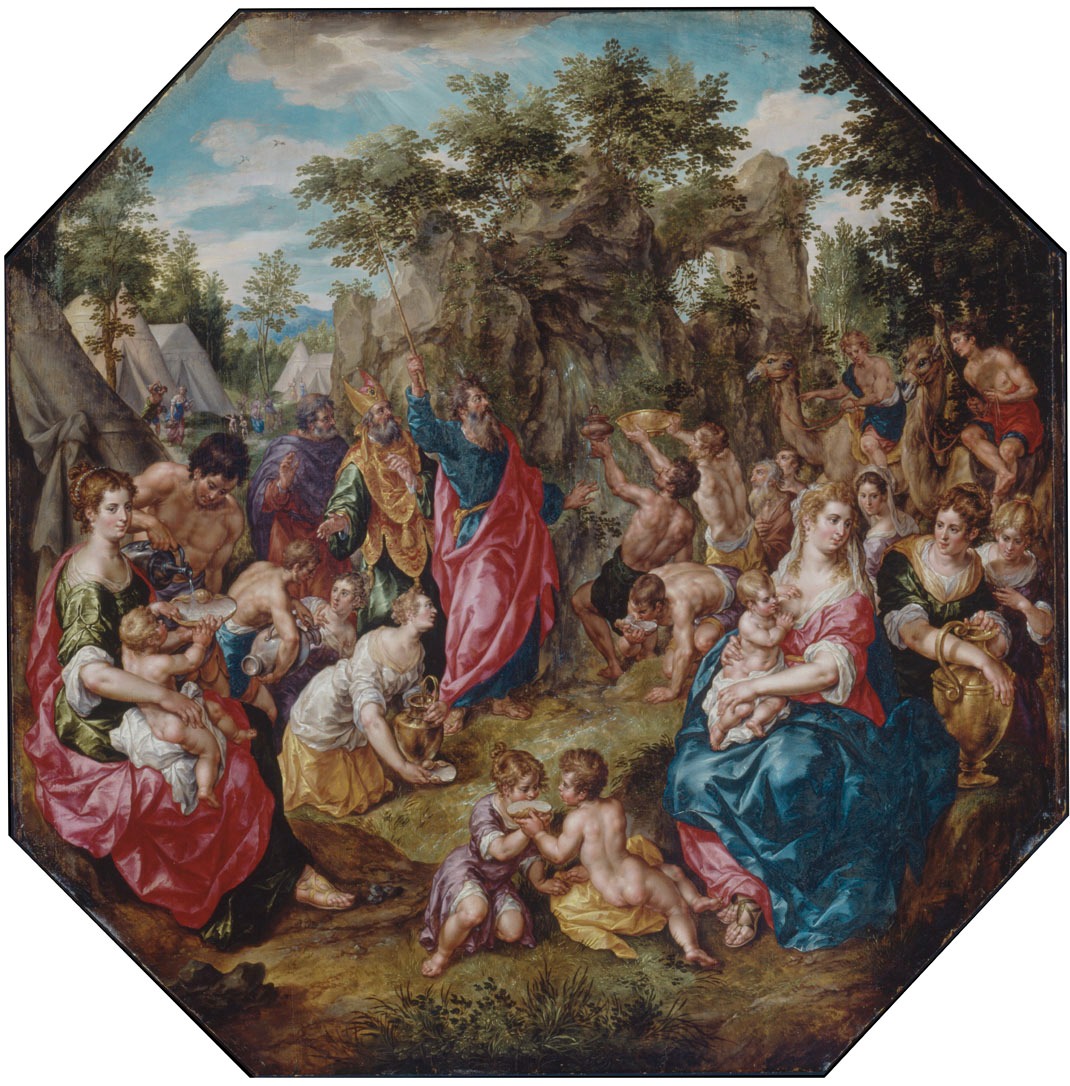
Hendrick de Clerck, Moses Striking the Rock (Oil on wood, 86.4 x 86.4 cm, 1590: Montreal Museum of Fine Arts, Montreal)
In de Clerck’s depiction of the Old Testament story, Moses is placed in the middle ground of the piece, framed by the figures in the foreground. The scene of Moses striking the rock is not the focus of the piece, but is also visible enough to denote to viewers the Biblical reference being made. The foreground is filled with non-Biblical figures that pose no threat of idolization. The one Biblical figure in de Clerck’s work, Moses, is presented with much more plain coloured clothes, and is placed far enough back that his facial expression is not even recognizable. De Clerck created a version of Moses that is not the focus of the theme for the piece. Moses being in this work is key to the story and to its sacredness, but it is not key to the messages of Protestantism or the theme of community. The image of everyone drinking the water and relaxing is much more important to the artist’s adaptation of the Biblical story, since de Clerck took the sacred work and turned it into a post-reformation depiction.
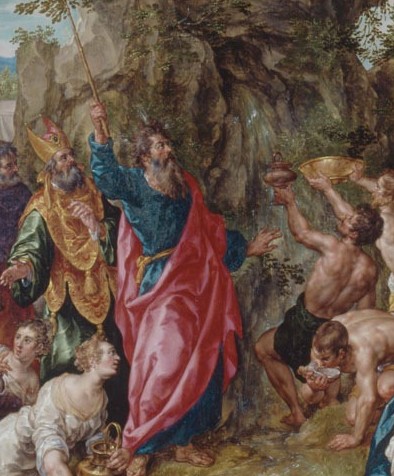
Depicting a Biblical story in a work of art still held importance for Protestants in the Northern Renaissance, as these works were educational to the story of God. Post-reformation artists valued the stories of the Bible, but were not interested in creating theatrical depictions of them. De Clerck’s Moses Striking the Rock follows this trend by depicting a less theatrical version of its story for viewers. In an earlier version of Moses Striking the Rock (1590) by de Clerck, Moses is depicted with bright blue and red clothes, waiving his staff in the air, and taking up more space with the painting than the 1610 version. The earlier version of Moses is placed in a much more prominent pose, giving the figure a greater sense of importance for the story. For post-reformation art, the focus on Biblical characters was less theatrical and more reminiscent of the original stories. This artwork follows that standard, and even depicts Moses in the process of tapping the large stone with his staff rather than swinging the staff in the air as a gesture of triumph. By following the original story in his work, and creating a less dramatic version of the characters, de Clerck created a sacred work of art that also adheres to post-reformation values.
Conclusion
Hendrick de Clerck’s Moses Striking the Rock (1610) is a sacred work of art from the early 17th century, influenced by both Italian and post-reformation styles. Despite it being a sacred work of art, the artist chose to carefully depict the Biblical scene through a Protestant lens by drawing viewers attention away from idolizing Moses. Values in Christianity, such as community and centrality, continued to be important for new Protestant believers. These values were implemented into art, both sacred and secular, to exemplify the Christian ideals in un-idolizing ways. It was important for post-reformation artists to create works of art in this way, as the new Protestant values were highly regarded in the 17th century Netherlandish art world. This is seen in Moses Striking the Rock, as the piece exemplifies post-reformation ideals through its formal characteristics, its theme of community, and the depictions of a Biblical story as an education tool. De Clerck created an un-idolizing, sacred work of art fit for the new post-reformation world of the Northern Renaissance.
More on the Topic…
Chiara de Capoa. Old Testament Figures in Art. Edited by Stefano Zuffi, Translated by Thomas Michael Hartmann, Getty Publications, 2003.
Tom Scott. The Early Reformation in Germany: Between Secular Impact and Radical Vision. Ashgate, 2013.
Truus van Bueren, Paul Cockerham, Caroline Horch, Martine Meuwese, and Thomas Schilp, eds. Reformations and Their Impact on the Culture of Memoria. Brepols, 2016.
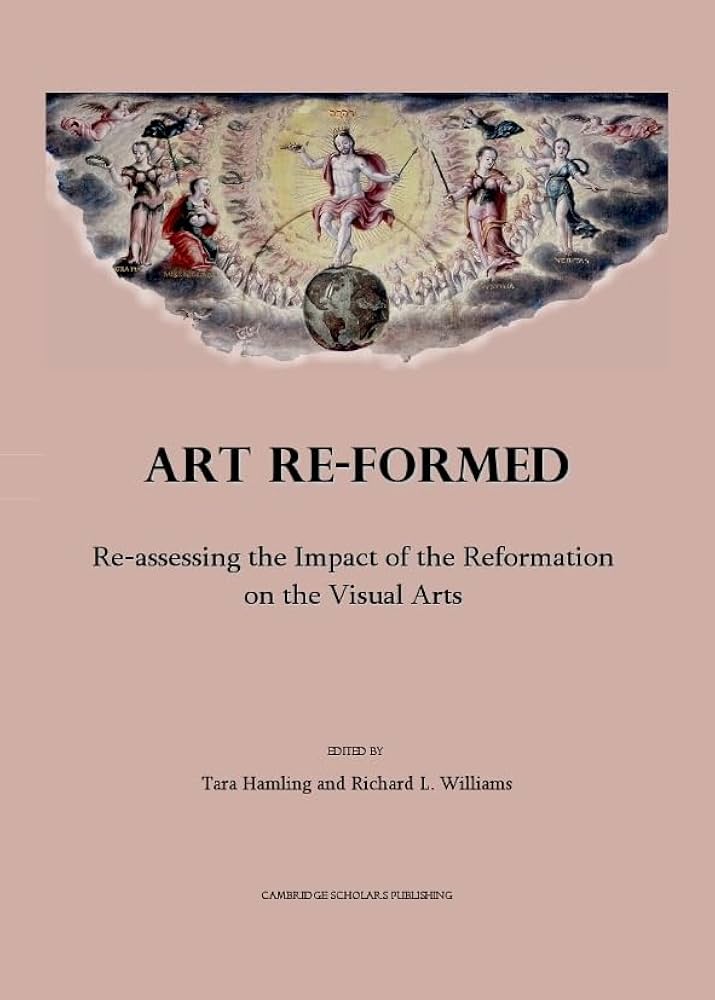
Tara Hamling and Richard L. Williams. Art re-formed: re-assessing the impact of the Reformation on the visual arts. Cambridge Scholars Publishing, 2007.
Flavie Deveaux
Bibliography: Hippo, August. The City of God. 426 AD; De Capoa, Chiara. Old Testament Figures in Art. Edited by Stefano Zuffi, Translated by Thomas Michael Hartmann, Getty Publications, 2003; Grislis, Egil. “The manner of Christ’s eucharistic presence according to Martin Luther.” Consensus 7, No. 7, Scholars Commons at Laurier, 1981; Krasnikova, Alena. “Hendrick de Clerck’s Moses Striking the Rock: Turning Religion into a Myth.” Family Works, Concordia University, 2018; Lafontaine, Patricia. “The Master of the Household: Images of Women in Seventeenth-Century Dutch Art.” Masters Thesis, University of Glasgow, 2000; Luther, Martin. “The Ninety-Five Thesis”. PDF, antilogicalism.com, 1517; Rosenfeld, Myra N. “Two Versions of Moses by Hendrick de Clerck.” Vie des Arts 25, No. 100 (1980): 86-90; Sahi, Jyoti. “The Open Well as Symbol of the Meeting of Heaven and Earth.” Religions 13, No. 103, Edited by Michelle Voss Roberts and Chad M. Bauman, MDPI Publishing, 2022; Wilsey, John D. “The Impact of the Reformation on the Fine Arts.” SOR Faculty Publications and Presentations (2006): 31-54.

