
The Bestiaries
Medieval people believed plants and animals existed alongside humans not only to sustain life but also to teach us how to live. The English theologian Thomas of Chobham (ca. 1160-1236) discussed the educational existence of animals in his treatise on preaching, stating “The Lord… created different creatures with different natures not only for the sustenance of men, but also for their instruction, so that through the same creatures we may contemplate not only what may be useful to us in the body, but also what may be useful in the soul.” Medieval people believed that motifs of animals or plants thus functioned as spiritual tools. Although early medieval scholars such as Isidore of Seville (ca. 560-636) and Saint Ambrose (ca. 339-397) first established the medieval bestiaries (texts dedicated to this ideology on animals), it build upon ancient philosophies and zoology. By the 12th century, a growing interest in nature sparked a revival for medieval bestiary studies, and figures such as Peter of Cornwall (ca. 1139-1221) linked the work of Seville and Ambrose with contemporary theology.
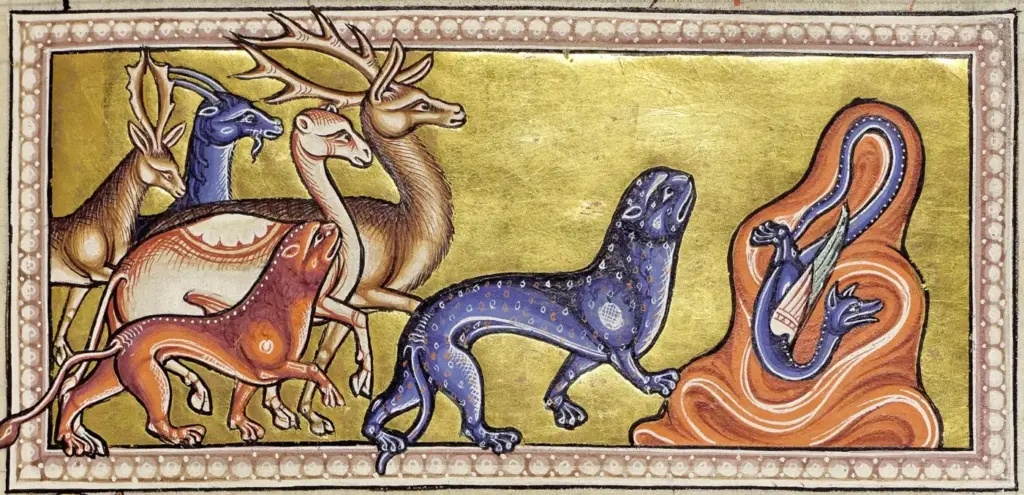
Detail of several animals including panther and deer. Folio 9r in The Aberdeen Bestiary (Ink and gilding on paper, ca. 12th century: University of Aberdeen, Aberdeen)
Christ as Sexless Animals in Nature
As this post wishes to discuss, certain creatures identified in medieval bestiaries were believed to be asexual and thus of spiritual perfection. This includes the phoenix, bees, silkworms, and elephants. Debra Hassig notes that bees “are to be commended as well for their complete lack of interest in sex: they neither engage in sexual intercourse nor are they troubled by illicit desires or the pain of childbirth. This leaves them free to concentrate on the good of their community and to serve their [queen (believed to be a king during the Middle Ages)], to whom they pay the greatest devotion.” Other animals, such as elephants, were recognised as chaste, reproducing sexually but having the ability to control their own sexual desires.
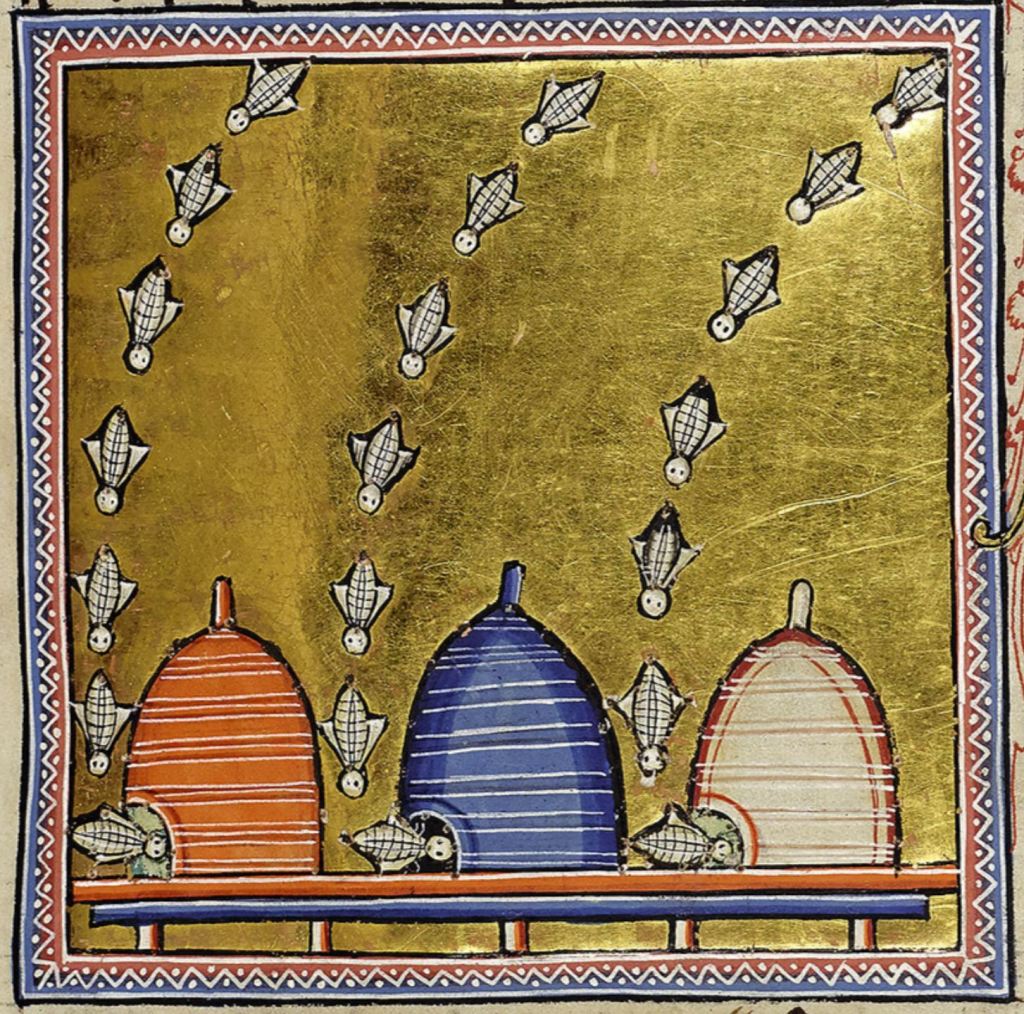
Detail of bees flying inside bees nests. Folio 63r in The Aberdeen Bestiary Aberdeen (Ink and gilding on paper, ca. 12th century: University of Aberdeen, Aberdeen)
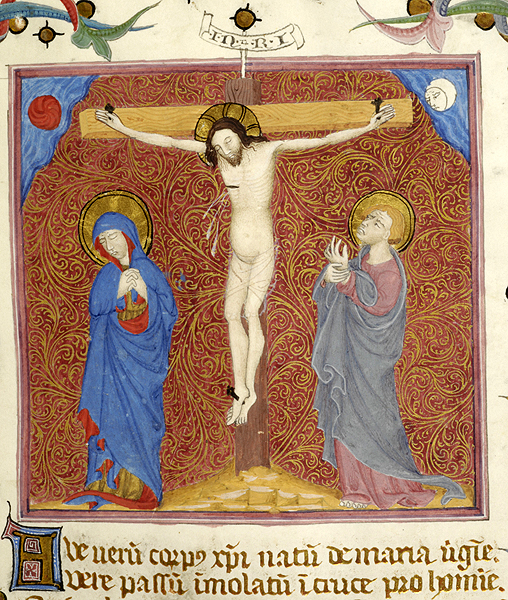
Detail of a naked Christ on the cross. Folio 3r in MS 300 (Ink on paper, ca. 1411: Morgan Library, New York City)
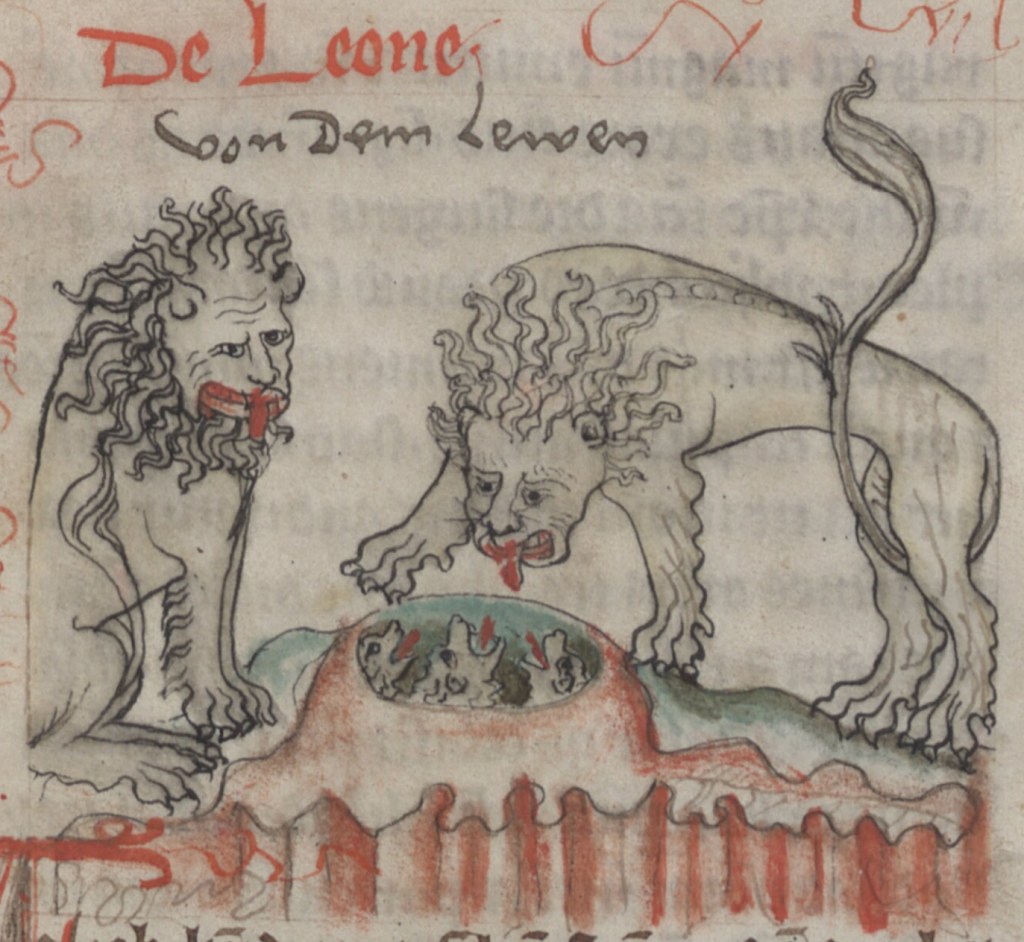
Detail of two lions with their three cubs. Folio 78r in Liber de Natura Rerum / Fürstenfelder Physiologus (Ink on paper, ca. 14th century: Bayerische Staatsbibliothek, Munich)
Scholars have argued that medieval Christians saw male and female sexes as connected, where the ovaries were just inverted testicles, and where sex had to do with body temperature and humours. Animal claws, horns, and excess fur were recognised as markers of sex because they were believed to be caused by excess humours and a lack of menstruation and sweating. It was also understood that these humours could change in a person, so that a man could end up cold and wet and thus female. Therefore, “biological” sex was not seen as a stagnant condition defined at birth, and what we call “transgender” today was not only accepted by contemporary Catholics but it was associated with purity and heaven. This is because Christ was seen by the Church as both male and female. While depictions of Christ’s naked body on the cross highlight his penis, they also highlight his side wound which was compared to a vagina. Christ as a dual-sex figure connects to the bestiaries as well, because pure and sexless animals could become representations of Christ. For instance, the lion and the unicorn are both associated with Christ in the medieval bestiaries, as the lion represents his resurrection (or Christ’s place on the throne of heaven) and the unicorn represents the crucifixion (or Christ’s death). The panther then represents Christ’s life on earth.
Hildigard von Bingen wrote about men’s lust as a weakness of humours that clergymen needed to expel regularly. While women menstruate to release their humours regularly, men were encouraged to jump in cold water or touch cool stones, such as the ones that churches were made from. Since gender was connected to the body’s use of reproduction, those who existed as a third gender or a blending of female and male are understood to not have exercised their reproductive organs as a means of transforming their bodies into something other than male or female. Monks such as Ælred of Rievaulx (1110-1167), even had cold water vats installed in their monastic cells so they could easily and frequently cool down their lust and reshape their sex into third gender beings.
Animal Lessons and their Materials
Motis of animals (as well as plants) could be incorporated into everyday life in various ways. This includes on clothing and accessories, which is evident in the use of iconographic rings or wearable reliquaries. Both of these objects were believed to possess inherent spiritual powers, so that, for instance, pregnant women who wore rings with the image of Saint Margaret could ensure a safe pregnancy. Materials were also associated with the sexlessness and purity of animals.
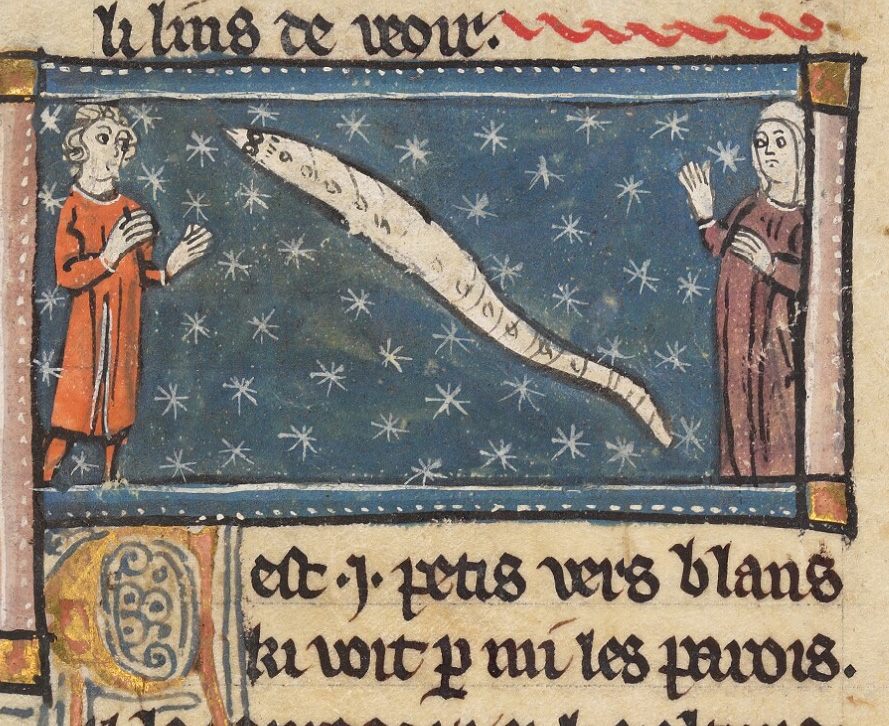
Detail of a worm. Folio 93r in Bestiaire D’Amour (Ink on paper, ca. 1309-1325: Bodleian Library, Oxford)
In his Etymologiae (ca. 625), Isidore, Archbishop of Seville wrote of his belief that most worms were born out of asexual conception and thus represented a sexless nature and a celibate lifestyle.
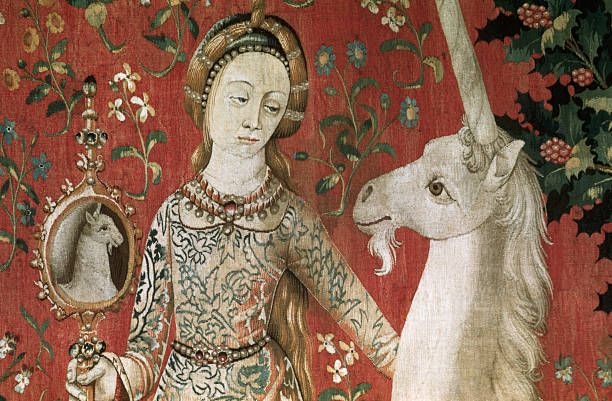
Detail of a lady and a unicorn. The Lady and the Unicorn Tapestries (Woven silk, ca. 1500: The Cluny Museum, Paris)
The story of the unicorn explained that only a virgin could capture it and thus depictions of figures next to unicorns (such as the Lady and the Unicorn tapestries, ca. 1500) highlights the virginity of the main figure (typically a young woman).
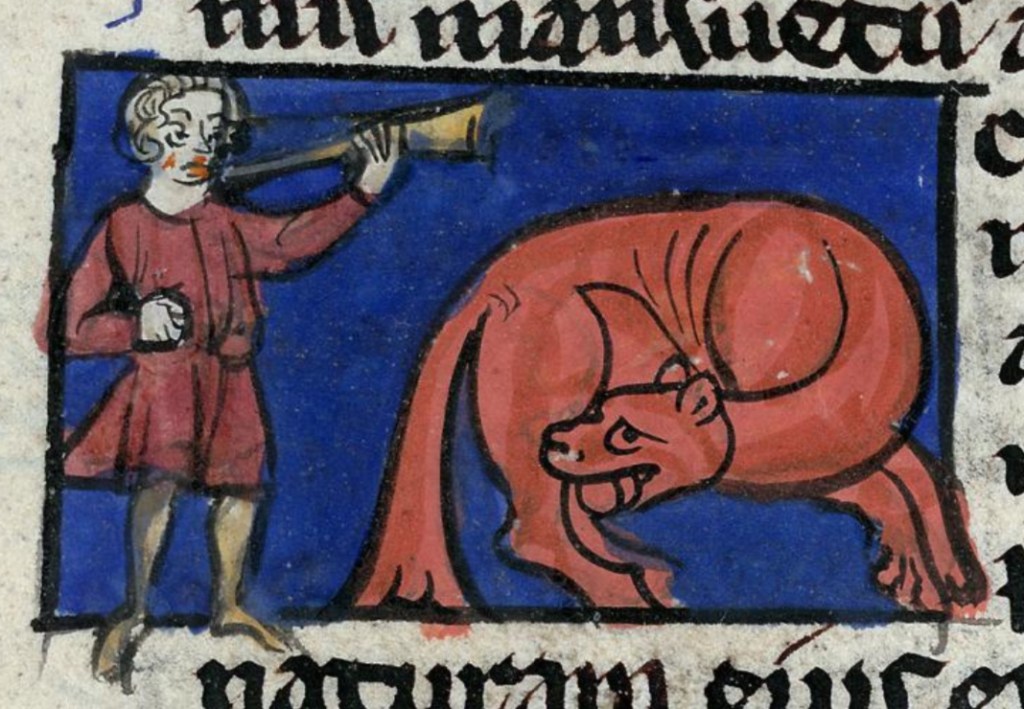
Detail of a beaver chewing on its genitals. Folio 191r in The Bestiary of Hugh of Fouilloy (Ink on paper, ca. 1240: Bibliothèque Municipale de Valenciennes, Valenciennes)
The image of a beaver chewing his off own testicles and throwing them at a hunter chasing him, is an allegory for the need to throw away one’s lewdness. Thus, the beaver becomes a symbol for chastity.
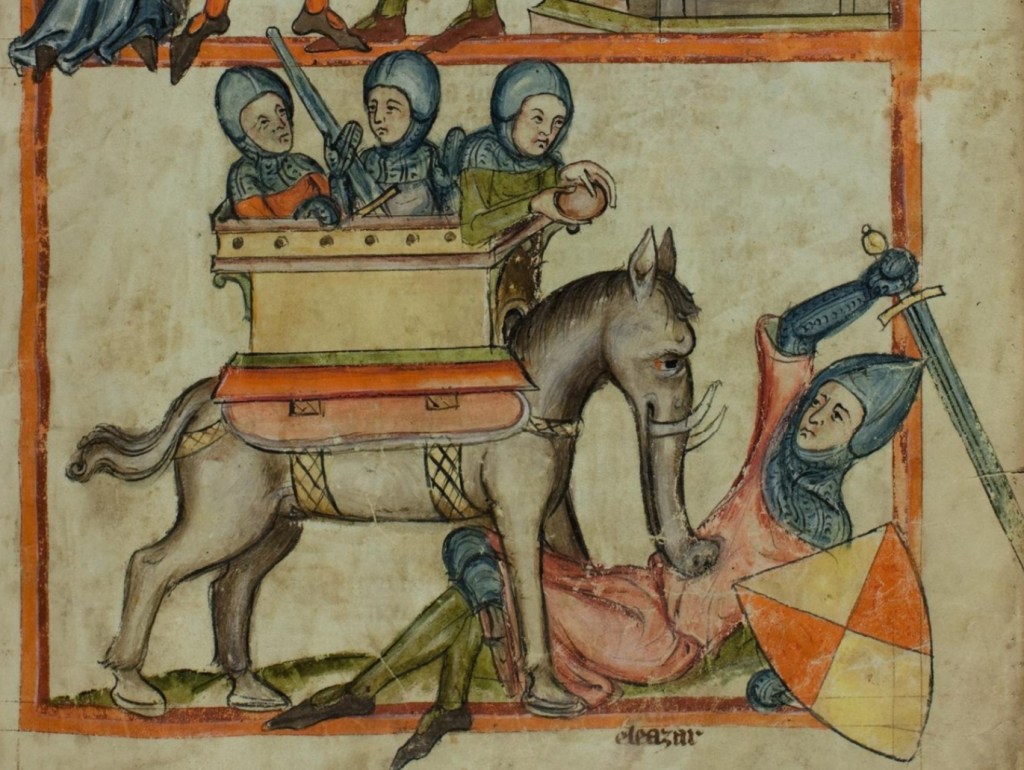
Detail of an elephant during battle. Folio 39r in Speculum Humanae Salvationis (Ink on paper, ca. mid-14th century: Badische Landesbibliothek, Karlsruhe)
The existence of sexless animals such as the oyster and elephant, existed not only to educate people on celibacy but they were also recognised as proof of God’s ability to create life through immaculate conception and thus proof that sexless beings exist on earth.
Motis of animals (as well as plants) could be incorporated into everyday life in various ways. This includes on clothing and accessories, which is evident in the use of iconographic rings or wearable reliquaries. Both of these objects were believed to possess inherent spiritual powers, so that, for instance, pregnant women who wore rings with the image of Saint Margaret could ensure a safe pregnancy. Materials were also associated with the sexlessness and purity of animals. For example, contemporary theologians recognised coral as asexual, and therefore beads of Corallium Rubrum (a red-orange colour coral) became popular on liturgical garments for its association with purity. The red-orange colour then became associated with blood; combined with purity, the material came to represent Christ’s bleeding heart.
Through the medieval bestiaries, oysters and pearls became connected with not only asexuality but also the Virgin Mary. This was done through the Madonna’s connection to the ocean as the stella maris (“ocean star”), as well as Her immaculate conception. Christ’s conception was believed to occur through rays of light entering the Virgin’s ear, which is reminiscent of the belief that pearls were created when light penetrated an oyster through the water. In Robert of Flamborough’s (d. 1224) Liber Poenitentialis (early 13th century) (a manual on the organisation and function of the Catholic Church), Flamborough writes about the tunics worn by the clergy. He notes that “the silk tunic traces its origin to worms, which are created without intercourse.” Here, Flamborough emphasises that silk was worn by ecclesiastical figures for its association with chastity and sexlessness, through the asexual nature of silkworms.
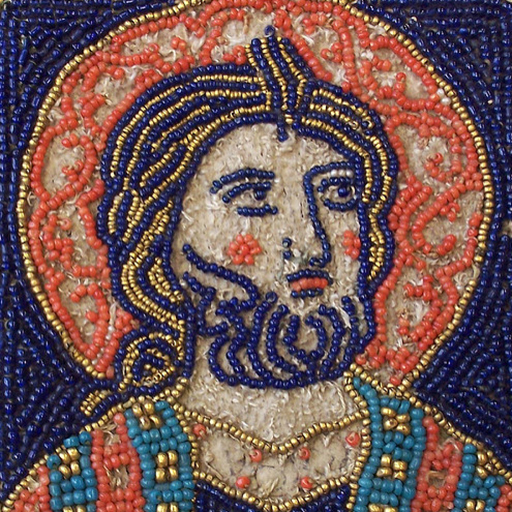
Detail of coral beads. (Embroidered parchment, ca. 1275-1300: Victoria & Albert Museum, London)
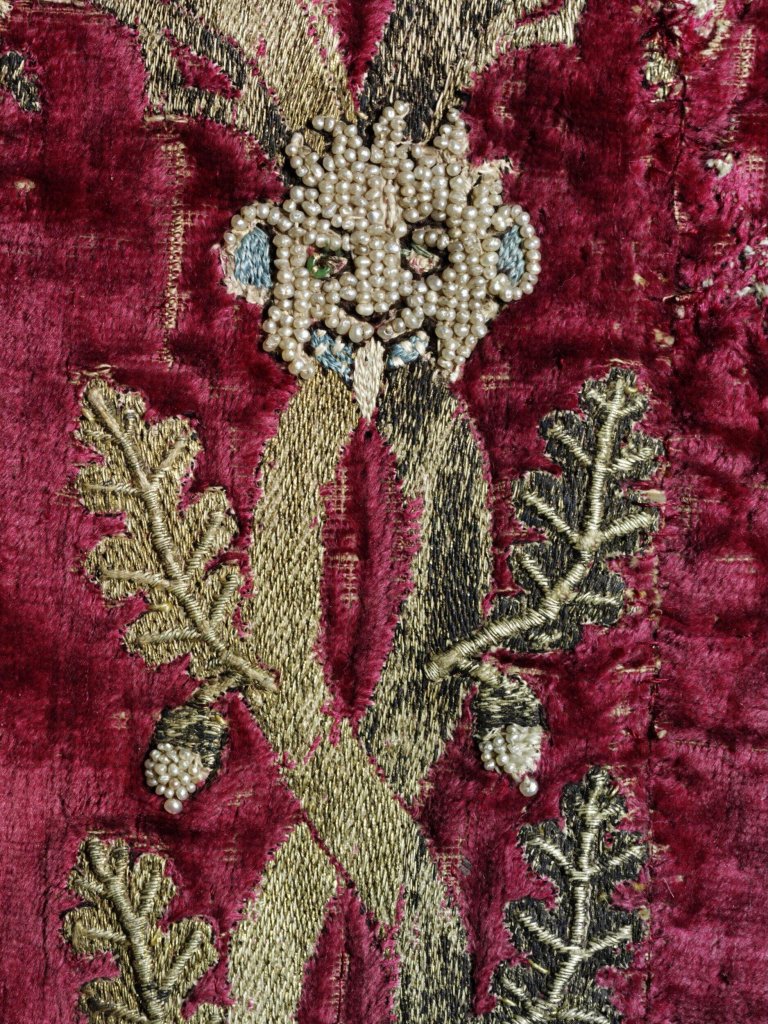
Detail of seed pearls in the shape of a lion’s head. Chichester-Constable Chasuble (Filé embroidered on velvet, ca. 1330-1350: The Metropolitan Museum of Art, New York City)
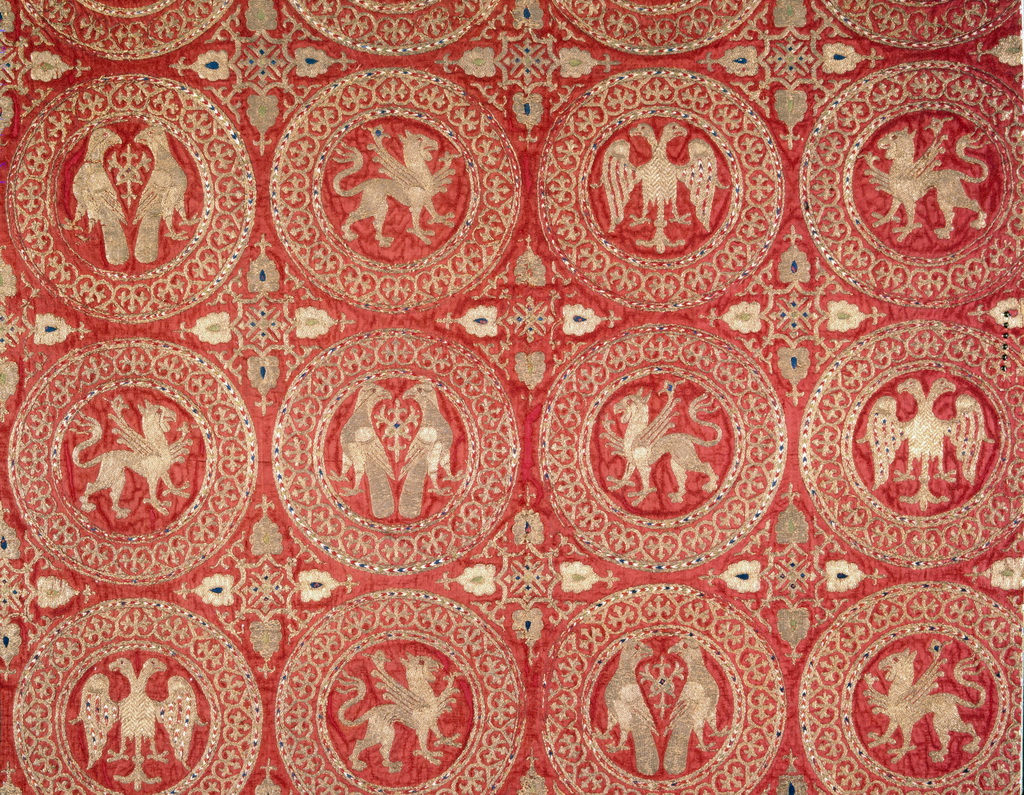
Detail of silk fabric woven with animal roundels. Cope Presented by Pope Boniface VIII (1294–1303) to the Cathedral of Anagni (Embroidery in silk and gold, mid-13th century: Museo del Tesoro della Cattedrale)
Sexless Angels and Asexual Ecclesiasts
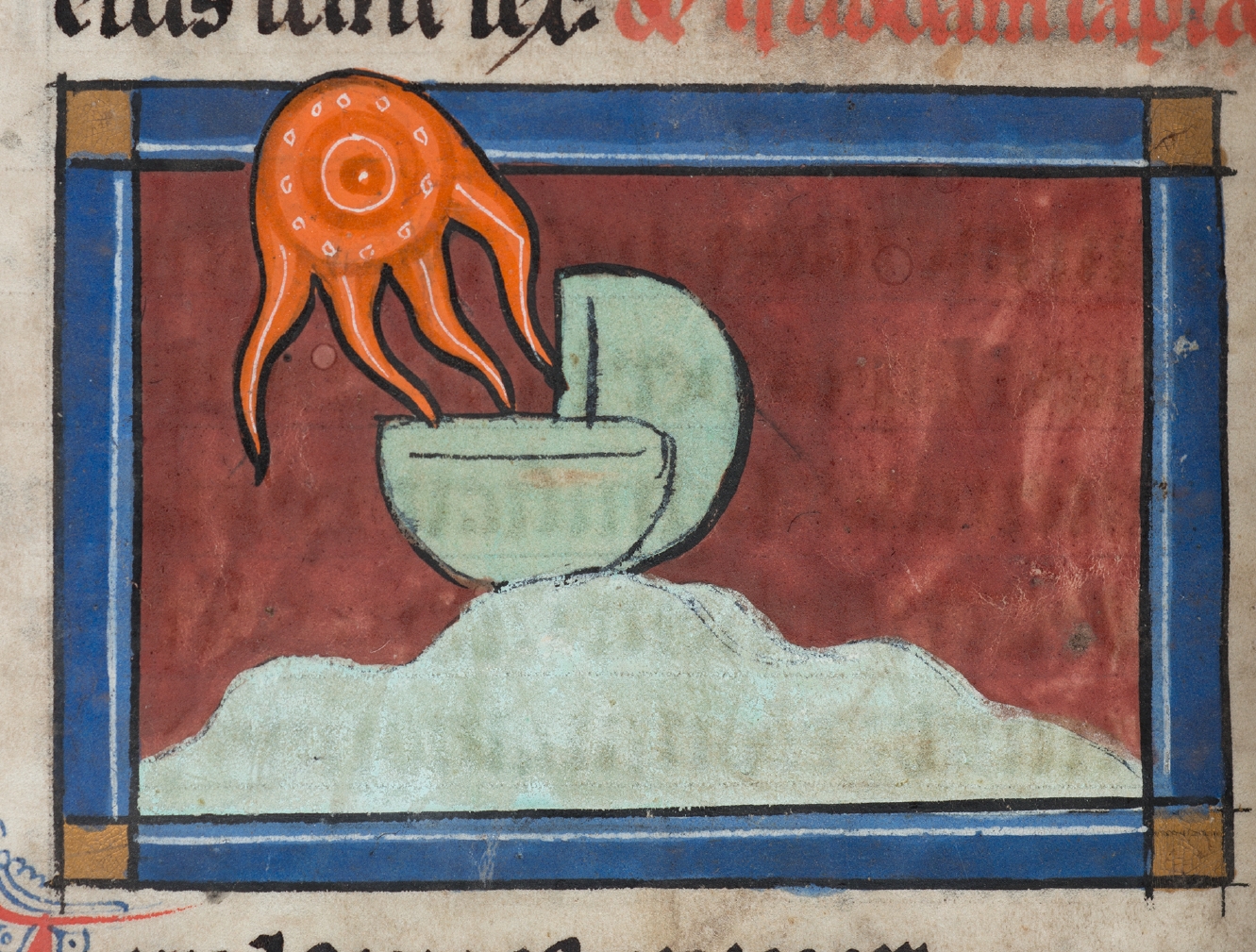
Detail of a sun shining light into an oyster. Folio 40v in Hugh of Fouilloy’s De Bestiis et Aliis Rebus Bestiary (Ink on paper, ca. 1250: The Warburg Institute, London)
The nature of angels and angelic beings gained prominence during the 11th to 13th centuries, as the Catholic Church sought virtuous figures to preach in place of Christ during Mass. In this pursuit, many bestiary manuscripts included copies of the Liber Penitentialis and the Liber de Vitiis, to educate and instil penance and bodily virtues through animals. In a 13th century manuscript containing William Peraldus’ (1190-1271) Liber de Vitiis, Folio 28v depicts a six-winged cherub standing triumphantly over a dragon. While many versions of the Liber de Vitiis include a six-winged cherub, Diane Elizabeth Heath notes that this artist represented contemporary theological understandings of angels and gender through the addition of a dragon figure representing the corrupt, sexual human body. Here, the cherub becomes a symbol for the new celibate form rising like a phoenix from the dragon’s body, just as ecclesiastical figures were meant to rise above the sexed bodies of the laity to become like angels servicing God. Clerical distinction was thus achieved during Mass by presenting ecclesiastical figures as angelic beings, where contemporary theologians and liturgical figures recognised clerical celibacy as a purging of the unvirtuous from the Catholic Church.
As a result, liturgical vestments began to feature more motifs of angel, serving as a reminder for ecclesiastical figures striving for an angelic bridal presence. In the Chichester-Constable Chasuble and Butler-Bowdon Cope, as well as the Göss Chasuble, angels surround the clerical body, concealing the corporeal form underneath and thus purifying it. The angelic figures on the Göss Chasuble are particularly noteworthy, as many are depicted with liturgical-style garments. Beginning in the 9th century, artists frequently depicted angels wearing liturgical vestments. Sandra Gorgievski argues that “angels can wear priestly robes as a sign of their common role” as both angels and clerics “propagate divine light and elevate human spirit.”
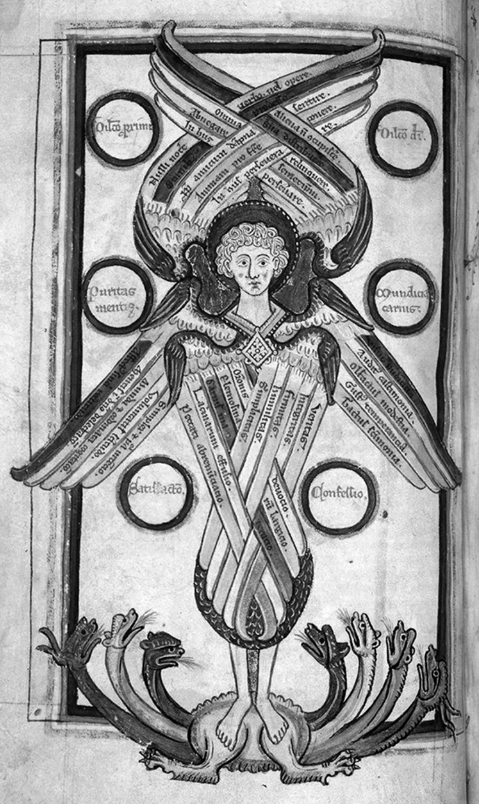
Folio 28v in the Harley Manuscript (Ink on parchment, post-1235 England: British Library, London)
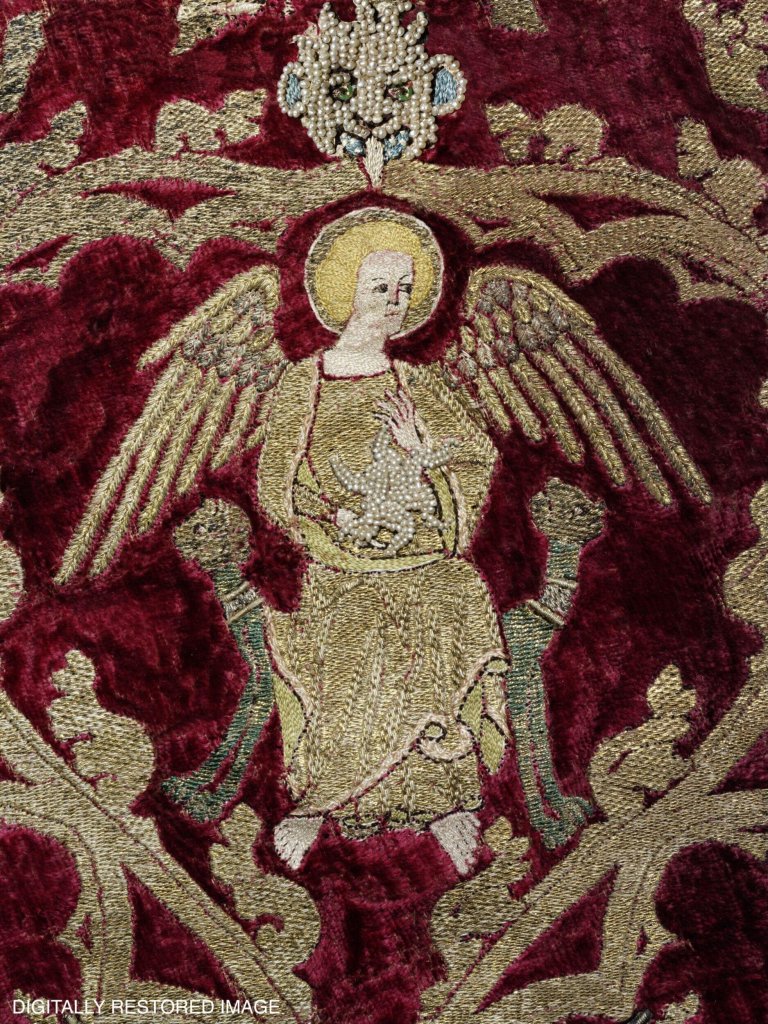
Detail of an angel sitting on a faldstool. Butler-Bowden Cope (Filé threads embroidered on velvet, ca. 1335-1345: Victoria & Albert Museum, London)
Although the Chichester-Constable Chasuble (and its matching cope known as the Butler-Bowden Cope), currently held at the Metropolitan Museum of Art, was reshaped in the early 16th century when the fashionable shape for chasubles changed, the main area of fabric on the front and back are original to the mid-14th century. This vestment was most likely produced in London, the centre of opus anglicanum production in the Middle Ages. The chasuble is unique among surviving examples because it depicts angels holding stars and seated on faldstools, which were ecclesiastical chairs reserved for bishops or higher-ranking clergymen. It is interesting to note this, as the Chichester-Constable Chasuble seems to suggest a visual connection between the bishops who wore this vestment and angels who sit on the same ‘thrones’ as popes, bishops, and the Virgin Mary all together. Despite this being a unique feature of surviving liturgical vestments, inventory records across western Europe show that other garments existed with similar designs, suggesting that this was more than a unique occurrence.
In the late Middle Ages, angels were understood to exist as incorporeal beings, meaning they lacked physical bodies and, consequently, had no need for sexual relations or procreation. As liturgical figures relinquish their sexual natures, they emulate the incorporeal nature of angels, transforming motifs of them into symbols of purity. This concept can also be extended to the stylization of the body through clothing, as clothing has long been used to disguise and represent the body within society. In Sermon 52 of his Series of Sermons on the Song of Songs (12th century), Bernard of Clairvaux describes his own desire for angelic assent, by comparing the death of angels and the loss of his corporeal state to the relinquishing of the senses that cause lust, anger, and care:
“Who will give me wings like a dove, so I might fly away and find rest? Let me die this death again and again: let me evade the snares of death; let me not feel the deadly lure of the sensuous life; let me be numb to sensual lust and passionate avarice, anger, and impatience, the anguish of worry and the miseries of care!… But, if I may say so, let me die the death of angels that, exceeding the memory of things present, I may liberate myself from desire for inferior and corporeal things so that I may purely converse with those who bear the likeness of purity. This kind of exceeding, whether wholly or in part, in my opinion, is called contemplation.”
Line Cecilie Engh explains that the “death of angels” referred to by Clairvaux, is an unearthly death where life is reversed, leading to paradisical quies or rest. This quies and the idea of vita angelica was often compared to the celibate and reclusive lives of monks. However, as Clairvaux writes “liberate myself from desire for inferior and corporeal things so that I may purely converse with those who bear the likeness of purity,” he implies that the corporeal vita angelica of monks was insufficient for high-ranking ecclesiastical figures to feel pure and closely connected with God.
In Conclusion
The medieval bestiaries gained significant attention and popularity from the 12th to early 14th centuries, reaching a level of popular comparable to the Psalters. The increased use of these motifs, became intertwined with the theological understandings of the angelic and sexless nature of holy figures that developed by the 13th century. Thus, the many motifs of animals, as well as plants, that decorate the vestments’ of medieval clerics, would have been associated with the virtues of each animal, transforming these motifs into something beyond mere beasts. These materials and icons became symbols of wealth and power through their representations of the angelic and asexual nature of animals and heavenly figures. This new ornate and symbolic nature of vestments provides insight into how high-ranking members of the Catholic Church embodied angelic spirits, with the imagery and materials related to sexlessness becoming identifiable symbols of powers that condition these ecclesiastical bodies to defy their bodily humours.
More on the Topic…
Willene B. Clark. A Medieval Book of Beasts: The Second-Family Bestiary: Commentary, Art, Text and Translation. Woodbridge: Boydell, 2006.
Line Cecilie Engh. Gendered Identities in Bernard of Clairvaux’s Sermons on the Song of Songs: Performing the Bride. Turnhout, Belgium: Brepolis, 2014.
Debra Hassig. Medieval Bestiaries: Text, Image, Ideology. Cambridge: Cambridge University Press, 1995.
Samantha J. E. Riches and Sarah Salih. Gender and Holiness: Men, Women and Saints in Late Medieval Europe. London: Routledge Publishing, 2002.
Flavie Deveaux
Bibliography: Ambrose. Hexameron, Paradise, and Cain and Abel. Translated by John J. Savage, New York: Fathers of the Church, 1961; Ashton, Gail. “Bridging the Difference: Reconceptualising the Angel in Medieval Hagiography.” Literature and Theology 16, No. 3 (2002): 235-247; Beckwith, Sarah. Christ’s Body: Identity, Culture and Society in Late Medieval Writings. London: Routledge, 1996; Berceo, Gonzalo de (13th century). Miracles of Our Lady. Translated and Introduction by Richard Terry Mount and Annette Grant Cash, Lexington: The University Press of Kentucky, 2015; Bloofield, Eleanor. “Sacred Staging: Dramatic Magic in the Medieval Mass.” Platform 12, No. 2 (Winter 2018): 34-48; Borgioli, Christina. “Wearing the Sacred: Images, Space, Identity in Liturgical Vestments (13th to 16th centuries).” Historia del Arte 6. Edited by Diane H. Bodart (2018): 169-195; Bynum, Caroline Walker. “The Body of Christ in the Later Middle Ages: A Reply to Leo Steinberg.” Renaissance Quarterly 39, No. 3 (1986): 399-439; Bynum, Caroline Walker. Jesus as Mother: Studies in the Spirituality of the High Middle Ages. Berkeley: University of California Press, 1982; Cassiodorus Senator, Flavius Magnus Aurelius (ca. 490-585). Cassiodorus: Explanation of the Psalms 1, Translation, introduction, and notes by P. G. Walsh, New York: Paulist Press, 1990; Cawley, A. C. Everyman, and Medieval Miracle Plays. New ed. London: J.M. Dent, 1993; Clark, Willene B. A Medieval Book of Beasts: The Second-Family Bestiary: Commentary, Art, Text and Translation. Woodbridge: Boydell, 2006; Coatsworth, Elizabeth, and Gale R Owen-Crocker. Clothing the Past: Surviving Garments from Early Medieval to Early Modern Western Europe. Brill Publishings, 2018; D’Avray, D. L. “Social and Other Interpretations.” The Preaching of the Friars: Sermons Diffused From Paris Before 1300. Oxford University Press, 1985; Doquang, Mailan S. The Lithic Garden: Nature and the Transformation of the Medieval Church. New York, NY: Oxford University Press, 2018; Drysdall, Denis L. The Routledge Companion to Medieval Iconography. Edited by Colum Hourihane. London: Routledge, Taylor & Francis Group, 2017; Durand, Guillaume. Durandus on the Sacred Vestments; an English Rendering of the Third Book of the “Rationale Divinorum Officiorum” of Durandus. With Notes, by the Rev. T.H. Passmore. England: T. Baker, 1899; Elliott, Dyan. “Dressing and Undressing the Clergy: The Rites of Ordination and Degradation.” Medieval Fabrications: Dress, Textiles, Cloth Work, and Other Cultural Imaginings. Edited by E. Jane Burn, New York: Palgrave (2004): 55-69; Elster, Christiane. “Inventories and Textiles of Papal Treasury around the Year 1300: Concepts of Papal Representation in Written and Material Media.” Inventories of Textiles – Textiles in Inventories: Studies on Late Medieval. Edited by Barbara Karl, & Thomas Ertl, Vienna University Press (2017): pp. 25-56; Engh, Line Cecilie. Gendered Identities in Bernard of Clairvaux’s Sermons on the Song of Songs: Performing the Bride. Turnhout, Belgium: Brepolis, 2014; Flamborough, Robert of (d. 1224). Liber poenitentialis; a critical edition with introduction and notes. Introduction and notes by J. J. Francis Firth, Toronto: Pontifical Institute of Mediaeval Studies, 1971; Gorgievski, Sandra. Face to Face with Angels: Images in Medieval Art and in Film. Jefferson, N.C: McFarland & Co., 2010; Harkins, Franklin T. “The Embodiment of Angels: A Debate in Mid-Thirteenth-Century Theology.” Recherches de Théologie et Philosophie Médiévales 78, No. 1 (2011): 25-58; Hassig, Debra. Medieval Bestiaries: Text, Image, Ideology. Cambridge: Cambridge University Press, 1995; Heath, Diane Elizabeth. “Boundary Blurring between the Monstrous, the Marvelous, and the Miraculous: The Battle between Virtues and Vices in a Thirteenth-Century Theological Miscellany.” Preternature: Critical and Historical Studies on the Preternatural 9, No. 1 (2020): 11-52; Hersfeld, Lambert von. The Annals of Lampert of Hersfeld (1074). Translation and notes by I. S Robinson, Manchester: Manchester University Press, 2015; Higgs Strickland, Debra et al. Medieval Bestiaries: New Approaches. Edited by Debrea Higgs Strickland, Leiden, The Netherlands: Brill, 14 Jul. 2025; Hindman, Sandra. “Medieval Iconographic Rings: Constructing a Cultural Context.” Codex Aqvilarensis 37 (2021): 485-502; Kapustka, Mateusz and Warren T. Woodfin. “Clothing the Sacred: An Introduction.” Clothing the Sacred: Medieval Textiles as Fabric, Form, and Metaphor. Edited by Mateusz Kapustka and Warren T. Woodfin, Textile Studies 8 (2015): 7-11; Keane, Marguerite. “5 Wearable Reliquaries, Metalwork, and Gems.” Material Culture and Queenship in 14th-century France. Leiden, The Netherlands: Brill (2016): 151-177; Laidlaw, Martin. “‘Yfallen out of Heigh Degree’: Chaucer’s Monk and Crises of Liminal Masculinities.” Gender in Medieval Places, Spaces and Thresholds. Edited by Victoria Blud, Diane Heath, and Einat Klafter, University of London Press (2019): 107-122; Lea, Henry Charles. History of Sacerdotal Celibacy in the Christian Church. United States: Houghton Mifflin & Company, 1884; Luttrell, C. A. “The Medieval Tradition of the Pearl Virginity.” Medium Ævum 31, No. 3 (1962): 194-200; Miller, Maureen C. “A Descriptive Language of Dominion? Curial Inventories, Clothing, and Papal Monarchy c. 1300.” Textile History 48, no. 2, Taylor & Francis Group (2017): 176-191; Miller, Maureen C. Clothing the Clergy: Virtue and Power in Medieval Europe, c. 800-1200: Virtue and Power in Medieval Europe, c. 800-1200. Cornell University Press, 2014; Murray, Jacqueline. “One Flesh, Two Sexes, Three Genders.” Gender and Christianity in Medieval Europe: New Perspectives. Edited by Lisa M. Bitel and Felice Lifshitz, Philadelphia: University of Pennsylvania Press (2008): 34-51; Nødseth, Ingrid Lunnan. “Corals, Blood and Precious Pearls: The Materiality of a Late Medieval Textile.” Konsthistorisk Tidskrift/Journal of Art History 86, No. 3, Taylor & Francis Online Publishings (2017): 173-187; Riches, Samantha J. E. and Sarah Salih. Gender and Holiness: Men, Women and Saints in Late Medieval Europe. London: Routledge Publishing, 2002; Ritchey, Sara Margaret. Holy Matter: Changing Perceptions of the Material World in Late Medieval Christianity. Ithaca: Cornell University Press, 2014; Ritchey, Sara. “Rethinking the Twelfth-Century Discovery of Nature.” The Journal of Medieval and Early Modern Studies 39, No. 2 (2009): 225-255; Rosati, Maria Ludovica. “De Opere Curioso Minuto: The Vestments of Benedict XI in Perugia.” Oriental Silks in Medieval Europe. Edited by Juliane von Fircks & Regula Schorta, ABEGG-Stiftung (2016): pp. 172-183; Sowerby, Richard. Angels in Early Medieval England. First edition. Oxford: Oxford University Press, 2016; Swanson, Robert N. “Angels Incarnate: Clergy and Masculinity from Gregorian Reform to Reformation.” Masculinity in Medieval Europe. Edited by Dawn Hadley, New York: Addison Wesley Longman, 1999; Tournai, Hériman de. Les miracles de Sainte Marie de Laon. Edited, translation, and notes by Alain Saint-Denis, CNRS Editions, 2008; Trexler, Richard. “Gendering Jesus Crucified.” Iconography at the Crossroads. Edited by Brendan Cassidy, Princeton University Press (1992): 107-120; Wardwell, Anne E. “Flight of the Phoenix: Crosscurrents in Late Thirteenth- to Fourteenth-Century Silk Patterns and Motifs.” The Bulletin of the Cleveland Museum of Art 74, No. 1 (1987): 2-35; Wilson, Joseph A.P. “The Life of the Saint and the Animal: Asian Religious Influence in the Medieval Christian West.” Journal for the Study of Religion, Nature and Culture 3, no. 2 (2009): 169-194; Winston-Allen, Anne. “Gardens of Heavenly and Earthly Delight: Medieval Gardens of the Imagination.” Neuphilologische Mitteilungen 99, No. 1 (1998): 83-92; Young, Bonnie et al. The Metropolitan Museum of Art Bulletin 29, No. 7, The Metropolitan Museum of Art Publishing, 1971.

