
In the 18th and 19th centuries, the British Empire expanded and incorporated a vast amount of land, resources, and people into “Great Britain.” The empire where “the sun never sets” gained this image through war, annexation, and seized control over various territories. By the late-19th century, this included Canada, Australia, New Zealand, Scotland, Ireland, Wales, Cape Colony (in modern day South Africa), Sierra Leone, Kenya, Uganda, Rhodesia, Nigeria, the islands of Jamaica, Trinidad and Tobago, Grenada, Barbados, Honduras, the Bahamas, two-thirds of the Indian subcontinent, parts of China, partial control over Egypt, and more. England’s vast control of the world was partially reflected in the many regiments and soldiers who fought in the British military until the end of World War Two. These non-English infantry regiments wore uniforms strategically designed to reflect England’s colonial control over the world. Hugh Trevor-Roper wrote that it was the romanticism movement of the late 18th and early 19th centuries that truly idealised “the cult of the noble savage whom civilisation threatened to destroy.” The English thud designed the uniforms of the Scottish, South Asian, Caribbean and African infantry regiments in particular, to emphasise the groups’ “savage” ethnicities, as the British Empire clung to power between 1857 and 1945. By displaying cultural symbols grafted together with English iconography and colonial ideas of “savagery,” regiments became walking displays of English colonial success over the “fighting races.” This is especially seen through the African (and Caribbean) uniforms, where invented ideas merged with racist stereotypes.
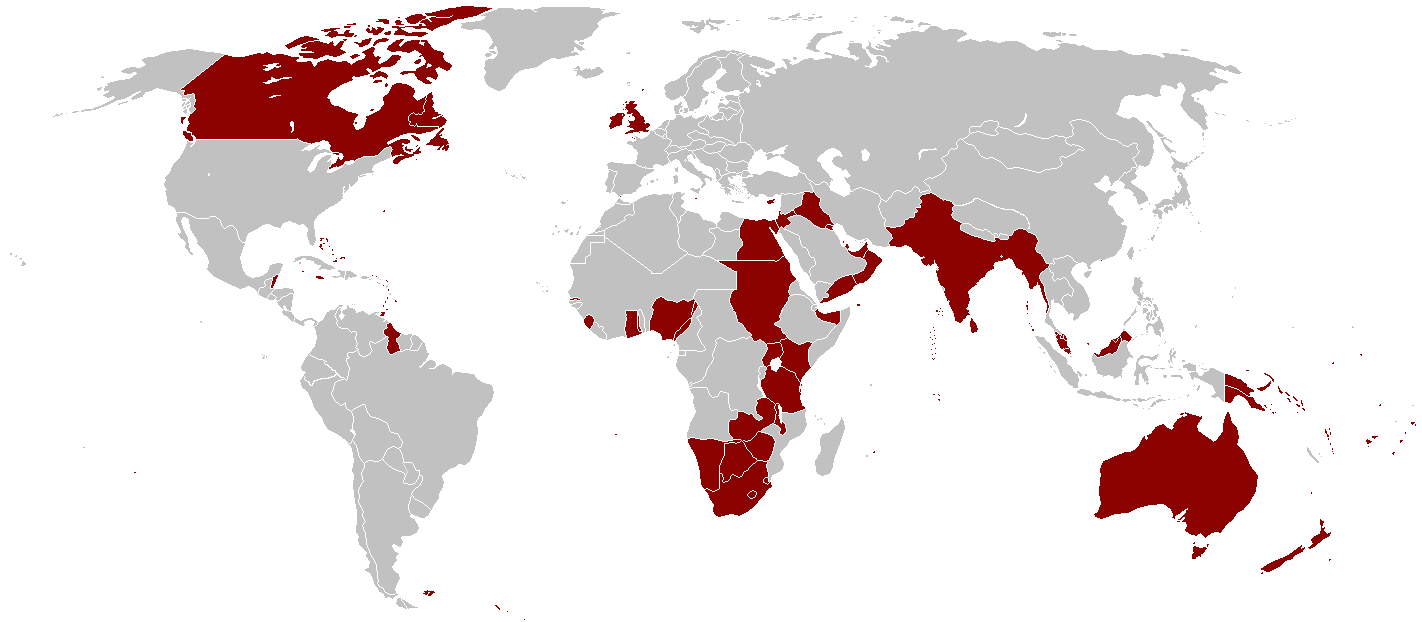
Map of British controlled territories during the 19th century
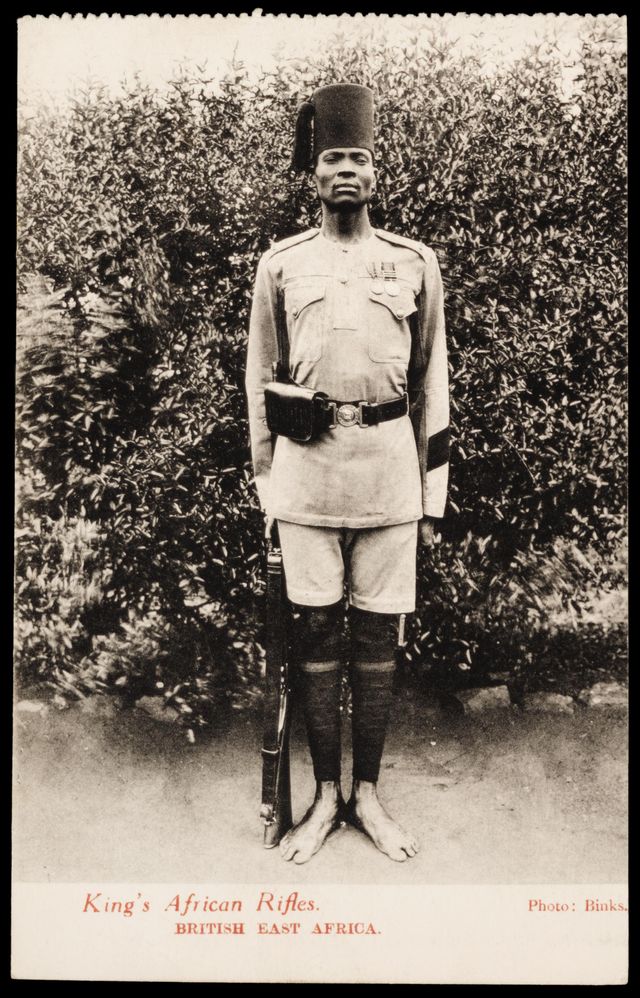
The Standard P & P Works Postcard Studio, King’s African Rifle, British East Africa (Ink on postcard paper; 32 x 29 cm; ca. 1890: The Humphrey Winterton Collection of East African Photographs, Northwestern University Library)
The English-African Soldier
Prior to the formation of the Kings African Rifles Regiment in 1902, there were several African Regiments under the British army, including the Uganda Rifles, the Central African Rifles, and the East African Rifles. These regiments had English officers and were used both in British military tactics and also as police for local areas under British control. The non-commissioned soldiers in these regiments mostly came from local tribes in Africa, but the English only allowed people from approved tribes to enlist. Soldiers from approved tribes in Central, Western, and Eastern Africa were considered superior fighters for their “hereditary hunting instincts and [naturally] intimate knowledge of the jungle-lore”. The British believed that people of African descent were the “bayonet strength” of the army, meaning they were “better suited” for bayonet fighting (which involves using a rifle like a spear by thrusting the bayonet-blade at the muzzle towards enemy soldiers) than gun fighting with “modern” rifles. Despite racist generalisations of people from Africa, the English-African army uniform mostly comprised of English-invented styles and clothing from non-African cultures, such as the use of khaki fabric and the Fezzes. This uniform was designed and issued to soldiers across African, whether in Egypt or modern-day South Africa, because the English considered all their people to be “the same.” Although the Fez originates from Türkiye, England’s partial control over Egypt in the late-19th century (an area close to Türkiye) also brought the British in contact with the Fez and led to the hat’s associated with the general idea of Africa.
The West India Regiment was first established in 1796 from British supporters in North Carolina who followed the English down to the Caribbean after the American Revolutionary War (1775-1783). During the early-19th century, the English-Caribbean regiments were mostly made up of freed enslaved people from West Africa; by the mid-19th century (after the abolishment of slavery in Great Britian, followed by the United States of America) these regiments mostly recruited Caribbean-born people. In 1858 the regimental uniform was completely redesigned to resemble the popular French-Zouave soldiers of North-West Africa. The connection that the English-Caribbean regiments held with Western Africa would later be used as evidence for adopting the Zouave style uniform, despite the fact that the Zouave uniform was invented by the French for their soldiers in North Africa. The Zouave uniform thus emphasises many European-made stereotypes about this region. In the English version of the Zouave uniform, Caribbean soldiers were separated from their English officers. The low-ranking soldiers wore a red vest with the bright yellow braiding sewn onto the front and back, over top of a beige Coatee. On their legs, Caribbean soldiers wore black Knickerbocker pants with matching yellow braiding running down the outside of both legs. These pants ballooned outwards and tapered after the knee. Below the puttees, the English originally issued soldiers a pair of sandals, which served no protection for the soldier’s feet. Despite this, Caribbean soldiers were used to practising drill with no shoes on at all. The balloon-shaped pants of the Zouave uniform lifted the fabric just below the knee so that the feet were left completely visible to the viewer, allowing the toes to stand out. This idea continued with the African regiments because the British-Caribbean colonies were filled with descendants of enslaved people from West Africa.
The Caribbean Zouave
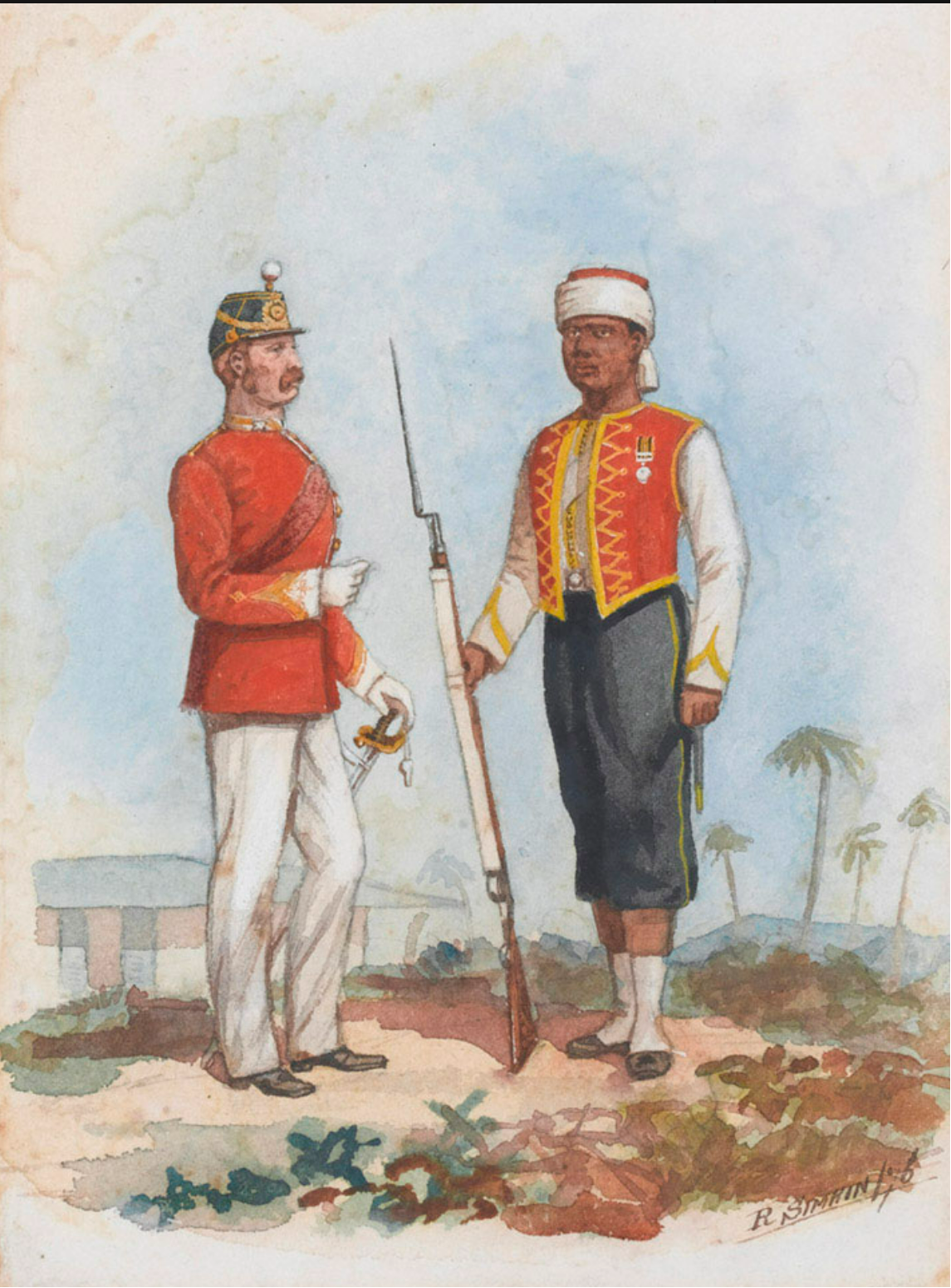
Richard Simkin, An officer and soldier of the 1st West India Regiment (Watercolour on paper, 1876: National Army Museum, London, Study Collection, NAM.2004-12-39-1)
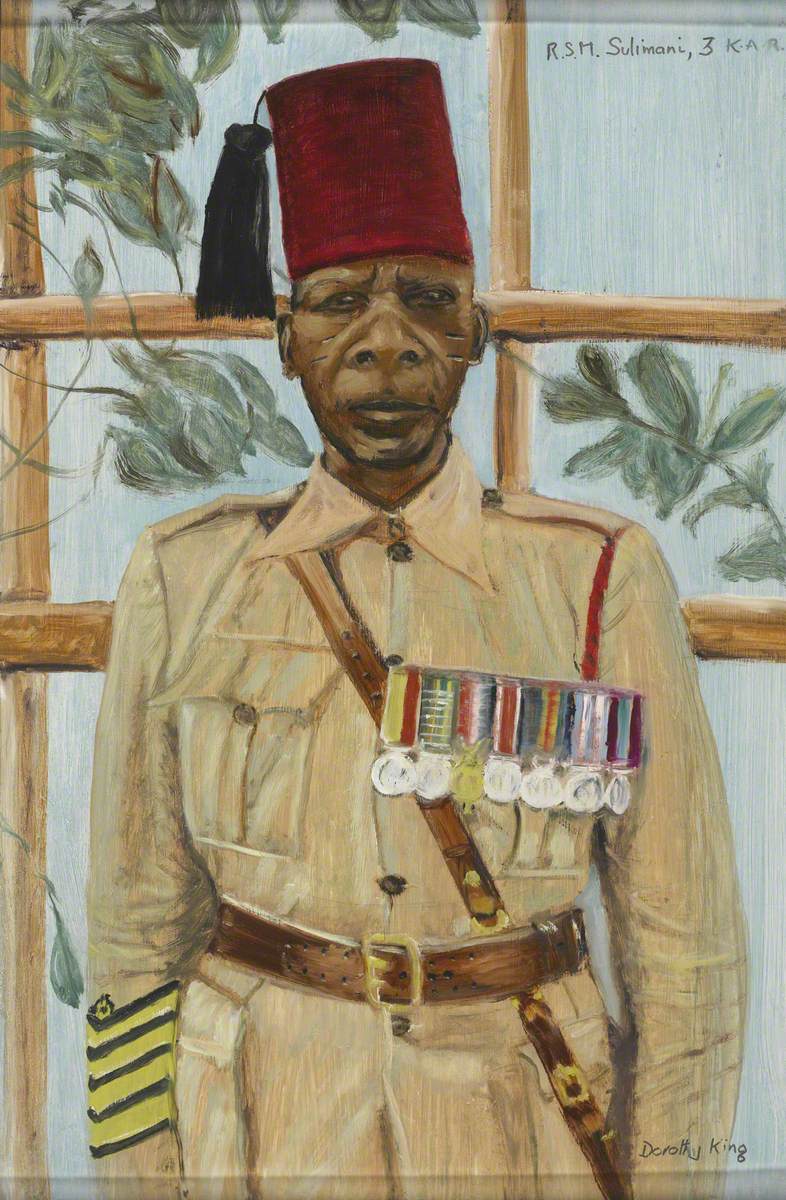
The full-dress uniform worn by African-born soldiers in the British army consisted of new styles designed specifically for the African regiments as well as elements taken from the English-Caribbean uniform. This includes a khaki doublet (or jacket) and shorts, a tall red or black tahboosh or fez with a tassel, sometimes a cummerbund or leather belt around the waist, occasionally a red Zouave vest, and various different coloured puttees (depending on the regiment) wrapped around the soldier’s bare legs. The fact that the name “khaki” is unrelated to any African language or culture (as it translates to “dust-coloured” in Persian), was of little to no concern for the English when they designed their African army uniform. Even today, khaki is often associated with the British-African soldiers that popularized its use in fashion. This is despite the fact that the khaki colour originates from South Asian cultures. During the Sepoy-Indian Mutiny (1857), soldiers dyed their white unfirms with coffee, curry, or mulberry juice as a form of rebellion against the English. By intentionally incorporating khaki into the uniforms of African soldiers, allowing the colour to become associated with the British army instead of freedom from the British, the English took away khaki’s power as a colour of rebellion for South Asian soldier. The colour may also be a reference to the North African deserts, which European viewers associated with this generalised “African” soldier created by the English. In particular, Egyptomania became popular in England by the late-19th century, with Ancient Egyptian artifacts being dug-up and brought back to England for the wealthy to display, sell, and (sometimes) eat. The khaki colour thus catered to European (particularly English) ideas of African people as a whole, and helped European viewers identify both the ethnicity of African soldiers and their subsequent control under the British Empire. The advancement of Anglo-Saxonism and genetic race theory from the 17th and 18th centuries had evolved into highly racist ideologies, characterised by the assumption of a superior position for the English individuals, while relegating African people to the lowest level.
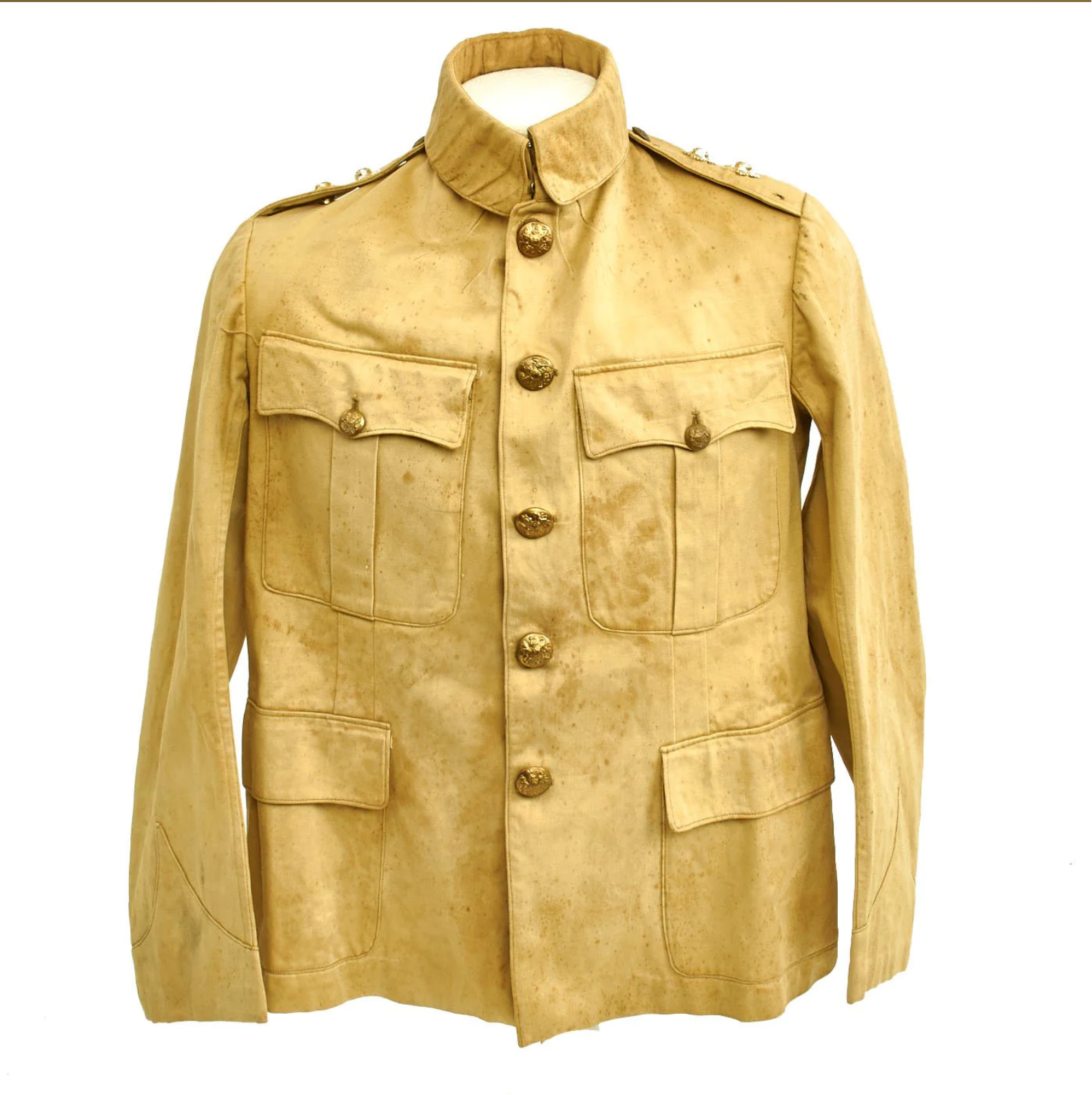
British Officer Khaki Tunic (Wool, khaki dye, cotton, brass, linen thread; 74 x 59 cm, ca. 1900: Private collection)
Anglo-Saxonism
In the 18th century Carl Linnaeus, a philosopher and “biologist,” published Systema Naturae, which categorised humans into four groups based on physical, mental, behavioural, and visual characteristics. Linnaeus believed that these traits were determined by genetics and included factors such as bile, phlegm, blood, governance styles, and clothing. These ideas were influenced by the Enlightenment period, which brought a more systematic understanding of ethnicity to the world, and European Imperialism would use genetic identity and ethnic differences to justify their colonial rule. It is in this setting that the English further developed the concept of Anglo-Saxonism, which contributed to a distinction between savage and civilised people and had a lasting impact on visual culture. The emergence of Anglo-Saxonism in the 18th and early 19th centuries utilised contemporary scientific theories to assert the belief that the English people descended from Germanic Goths, who in turn traced their origins back to the Indo-European Caucasians and the Aryans. This theory of Teutonic origin distinguished the Celts of Scotland and Irland from the Anglo-Saxons, as both physical and behavioural characteristics were considered to be different between the two groups. As the years went on, the theory of Anglo-Saxon superiority expanded to encompass various ideas, including the English people’s perceived destiny to rule the world, the belief that inferior races or cultures lacked the desire for freedom and thus desired to be ruled by the English, and the importance of demonstrating the superior success of the Empire to the rest of the world. Anglo-Saxonism and other European genetic studies during the 18th and 19th centuries concluded that racial differences were not capable of being altered and that such characteristics were an inherent part of a person’s genetic makeup. This ideology led to the categorisation of certain people based on predetermined skills in which they were considered to excel, including the concept of genetically superior fighters. As these ideas continued to grow into the mid-19th century, the British military would eventually create the term ‘martial race’ to identify certain ethnicities that the English believed to be “inferior in intellect and sophistication” but who were also believed to be “superior in fighting due to their lack of intellect and sophistication.”
The “African” Body
Note the Difference
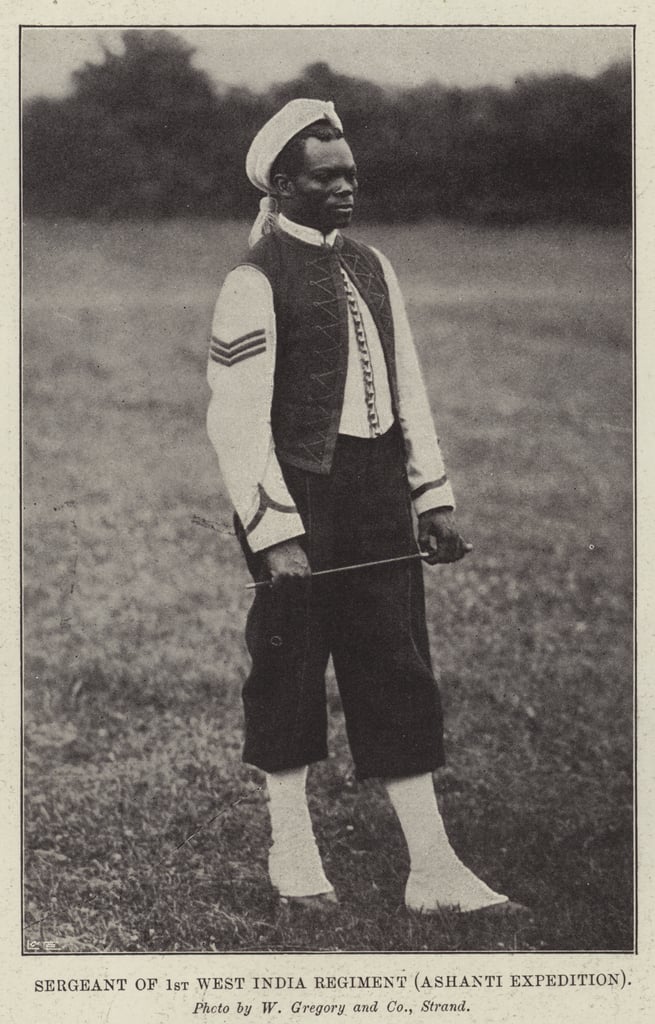
W. Gregory & Co. Strand, Sergeant of 1st West India Regiment (Ashanti Expedition) (Relief half-tone photo; ca. 19th century: Royal Collection Trust, RCIN 760622)
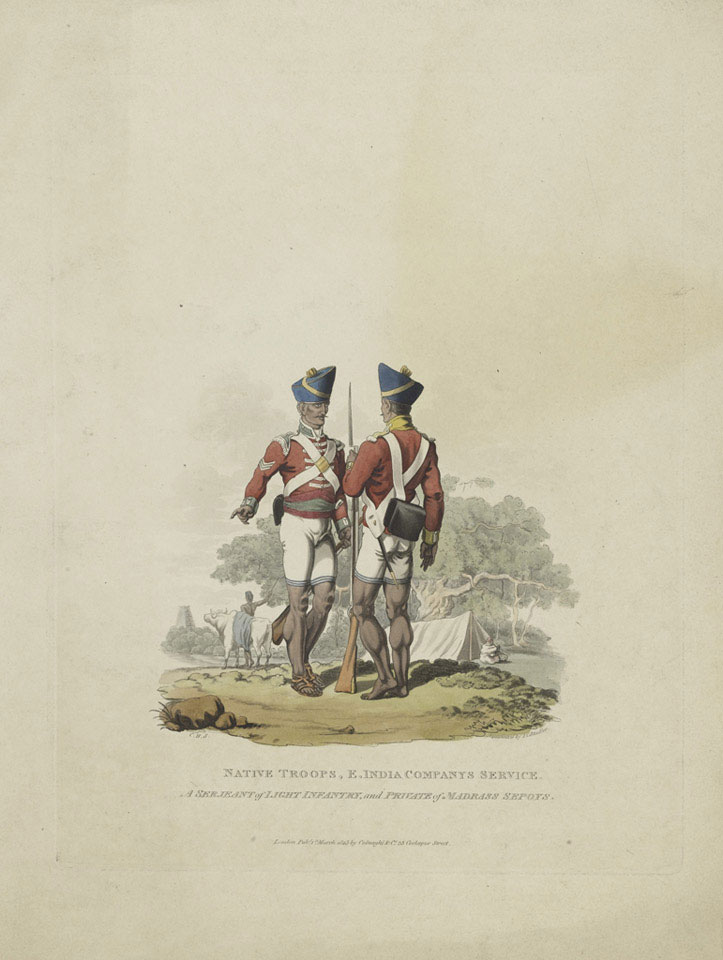
Charles Hamilton Smith, Light Company Havildar and Sepoy of a Battalion Company, Madras Native Infantry (ink on paper, 1812-1815; From Charles Hamilton Smith’s “Costumes of the Army of the British Empire, according to the last regulations of 1812” published by Colnaghi and Company, National Army Museum, London, Study Collection, NAM.1950-11-33-57)
Historian Terence Ranger wrote that the official attempts to colonise Africa began in the 1870s to 1890s, and by this point it was so late in the colonial period that colonial powers (such as the English) took more strategic and organised approaches to establishing invented traditions within African colonies. We can see this with the less colourful uniforms of the African Regiments, as the khaki fabric reflected contemporary military styles of the late 19th century. Unlike earlier English uniform designs that distinguished different cultural groups from one another, the concept of the African person was amalgamated into one entity and continuously compared to white colonizers. Rather than emphasising traditional and regional patterns, spiritual beliefs, or clothing, the English designed African army uniforms that highlighted the “African body” (an English-made concept in itself). Thus, English-African unforms include a ban on footwear because the English thought it looked “strange and unnatural” on the “African body,” while the white officers of these regiments continued to wear boots. Bare skin became common in 19th-century non-English army uniforms, likely because the English saw the bare skin of one’s leg as a sign of impurity and a lack of class. By highlighting the bare skin of African soldiers, the English were emphasising an invented “savagery” imposed upon these soldiers.
Records tell us that soldiers in British-African regiments sometimes requested shoes despite the ban (this includes requests from both the African-born soldiers and white officers who saw the lack of shoes as impractical), and many soldiers suffered from “cut foot,” an injury that put soldiers out of commission for days or weeks at a time. The English army finally issued shoes to their soldiers in Africa during World War One; however, the Chaplis they were given were sandals that frequently wore down and straps were known to break. Most of the soldiers that were issued Chaplis ended up carrying the sandals, forced to continue into battle barefoot. The idea that footwear seemed inappropriate for African soldiers unfortunately continued into the 20th century, and certain English officers from the 1930s are quoted as saying “the Hausas had enormous feet, and looked all wrong in boots.” This statement was not new though and came from colonial ideology which permeated the English army. Certain groups of people native to British territories in Africa, such as Hausa, Yoruba, and Matabele, were believed to be exemplary at scouting and spying due to their supposed “predestined genetic behaviours.” The African Regimental uniform was heavily influenced by Lord Baden-Powell, a man who eventually founded the Scouting institution. For this reason, the African khaki uniform reflects the same childlike style seen in the original Scouting uniforms because it was the scouting styles and abilities of the Matabele people that inspired Baden-Powell to found the Scout organisation at the end of the 19th century.
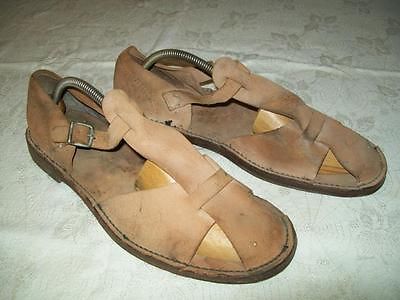
British Army Chaplis Sandals (Leather, metal buckles, ca. WW2: Private collection)
“it is hard to believe [Caribbean soldiers] would in fact have resented being clothed in identical fashion to the remainder of the [army].”
W. D. Cribbs in “Campaign Dress of the West India Regiments” (1992)
In the mid-1870s there was a call for changes to the West India Regimental uniform, as Commander in Chief of the Third Ashanti Expedition (1873-1874), Sir Garnet Wolseley, reported the unsuitable state of the current Zouave inspired costume. Changes were briefly implemented, giving Caribbean soldiers Elcho-Grey tweed jackets and tropical helmets that were more suited to the warmer environments in which the regiment tended to fight. However, the Zouave uniform was quickly reinstated as English viewers found the grey to be “drab,” with writer Frederick Boyle (1841-1914) stating in his book on the Ashanti expedition that “surely those who devised this [clothing] scheme never beheld a negro… in the old uniform I have no doubt he looked picturesque, and even martial.” Boyle’s perspective on the tweed uniform highlights the significance of visual representation for the British army and European observers, who preferred ethnocentric attire over practical ones for these regiments. Boyle also claimed that Caribbean soldiers felt “ashamed and angry” about the change to the grey tweed uniform because (according to Boyle) this uniform was too similar to that of regular English regiments. Author W. D. Cribbs writes that “it is hard to believe [Caribbean soldiers] would in fact have resented being clothed in identical fashion to the remainder of the [army].” Instead, Boyle likely fabricated this Caribbean soldier perspective in order to strengthen the benefit of the Zouave uniform. This is reflected in Boyle’s writing where he states “[nothing is] more ridiculous than this specimen soldier in helmet and suit of grey.” To contrast, the Zouave uniform was seen as “smart, colourful, picturesque, and suited to the climate and the people for whom it was designed.” The creation of a distinct uniform for the Caribbean colonies in the British army also showed a desire to create a separate identity which would distinguish them from English soldiers and would later connect the Caribbean soldiers back to their African heritage. Its bright colours added to the visual rhetoric established in the design and communicated to viewers that the British were successful in their control over pugnatoral groups such as this, who were considered genetically inclined to wear clothing distinct from superior European fashion.
In Conclusion
The British army used the image of the invented “African body” because the naked and supposedly “underdeveloped genetics” of various African cultures was the basis for the English racial superiority. In the 18th century, scientists believed that the physical qualities of a person determined their behaviour, and the English incorporated this idea into their uniforms by showing the exposed skin, bare feet, and the enhanced body of colonised soldiers. In a post-colonial world, these racist visual ideas are no longer science, but their iconography still permeates the world of fashion, military uniforms, and artistic depictions of colonised bodies. While English-African army uniforms showcase its development, these ideas can be found in all non-English, British army uniforms of the 19th and early-20th century, when colonialism peaked.
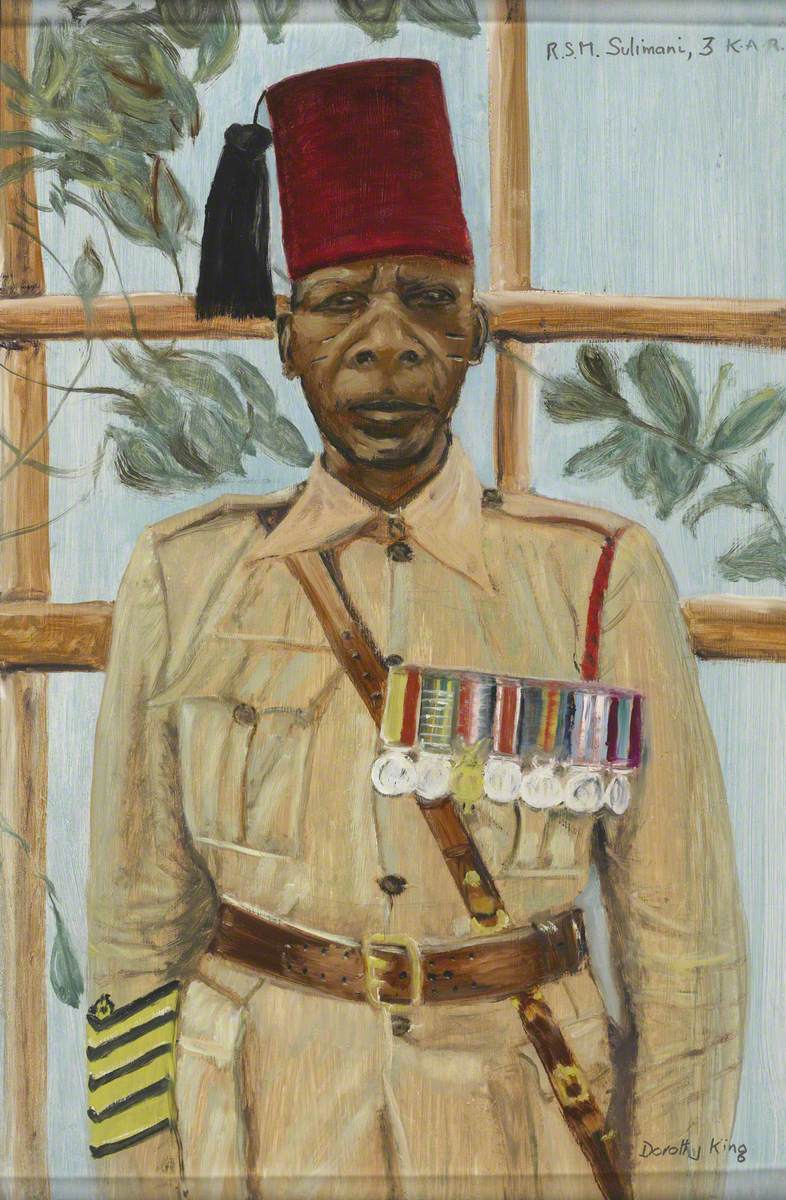
Dorothy King, Regimental Sergeant Major Sulimani, 3rd Battalion, King’s African Rifles (Oil on board, 61 x 40 cm, 1939: National Army Museum, London)
More on the Topic…
Tarak Barkawi. Soldiers of Empire: Indian and British Armies in World War II. Cambridge: Cambridge University Press, 2017.
Eric Hobsbawm and Terence Ranger. The Invention of Tradition. Canto Classics. Cambridge: Cambridge University Press, 2012.
Timothy J. Stapleton. West African Soldiers in Britain’s Colonial Army (1860-1960). University of Rochester Press, 2022.
Flavie Deveaux
Bibliography: Barkawi, Tarak. “Making Colonial Soldiers in British India.” In Soldiers of Empire: Indian and British Armies in World War II. Cambridge: Cambridge University Press (2017): 17-48; Barnes, Robert Money. Military Uniforms of Britain and the Empire: 1742 to the Present Time. The Imperial Services Library, V. 4. London: Seeley Service, 1960; Boyle, Frederick. Through Fanteeland to Coomassie: A Diary of the Ashantee Expedition. London: Chapman and Hall Publishers, 1874; Bremner, Fred (1863-1941). Types of the Indian Army: Illustrating the Races Enlisted in the Bengal, Punjab, Madras & Bombay Armies: Dedicated (by Permission) to His Excellency General Sir George Stewart White … Commander-In-Chief in India: Bengal and Punjab Armies. Nineteenth Century Collections Online (Ncco), Quetta, India, 1897; Cadell, Patrick. “The Uniforms of the Bombay Soldier.” In Journal of the Society of Army Historical Research 26, no. 108, Society for Army Historical Research Publishing (Winter 1948): 143-146; Cadell, Patrick. “The Uniforms of the Madras Army.” In Journal of the Society of Army Historical Research 27, no. 112, Society for Army Historical Research Publishing (Winter 1949): 171-175; Cohn, Bernand S. “Representing Authority in Victorian India.” In The Invention of Tradition, Edited by Eric Hobsbawm and Terence Ranger, Canto Classics. Cambridge: Cambridge University Press (2012): 165-210; Cribbs, W. D. “Campaign Dress of the West India Regiments”. In Journal of the Society for Army Historical Research 70, no. 283, Society of Army Historical Research Publishing (Autumn 1992): 174-188; “Early Scots Military Uniforms.” In The Scottish Antiquary, or, Northern Notes and Queries 15, no. 57 (1900): 26–34; Edmonds, Daphne. “Military Costume 1830-1860.” In Costume 3, no. 1, Routledge Publishing (1969): 21-23; Galster, Kjeld, and Marie-Louise Nosch. “Textile History and the Military: An Introduction.” In Textile History 41, no. Sup1 (2010): 1-5; Harris, R. G. “983. Unidentified Officers of the Indian Army, 1858 to 1870.” In Journal of the Society for Army Historical Research 40, no. 164, Society for Army Historical Research Publishing (1962): 218-221; Hobsbawm, Eric et al. The Invention of Tradition. Canto Classics. Edited by Eric Hobsbawm and Terence Ranger, New York: Cambridge University Press, 2012; Horsman, Reginald. “Origins of Racial Anglo-Saxonism in Great Britain before 1850.” In Journal of the History of Ideas 37, no. 3, University of Pennsylvania Press (1976): 387-410; Khare, Aditi. “The fabled Chintz: Global entanglement and South Asian agency in everyday British fashion, 1600–1800.” In Everyday Fashion: Interpreting British Clothing Since 1600. Edited by Bethan Bide, Jade Halbert, and Liz Tregenza, London: Bloomsbury Visual Arts (2023): 159-179; Linnaeus, Carl. Systema Naturae 1, 10th edition, Impensis Direct, 1758; Lloyd, Amy J. “The British Empire.” In British Library Newspapers. Detroit: University of Cambridge Press, Gale, 2007; Loscombe, A. R. (Colonel). The 1st Battalion West India Regiment: A Brief Historical Sketch. 1904; Macfie, Alexander Lyon. “Thuggee: An Orientalist Construction?” In Rethinking History 12, no. 3 (2008): 383-397; Moyse-Bartlett, Hubert (Lieutenant-Colonel). The King’s African Rifles. A Study in the Military History of East and Central Africa, 1890-1945. Aldershot England: Gale & Polden, 1956; Parramore, L. “The Egyptomania Craze.” In Reading the Sphinx. New York: Palgrave Macmillan (2008): 17-43; Peoples, Sharon. “Embodying the Military: Uniforms.” In Critical Studies in Men’s Fashion 1, no. 1, Australian National University Press (2014): 7-21; Ranger, Terence. “The Invention of Tradition in Colonial Africa.” In The Invention of Tradition, Edited by Eric Hobsbawm and Terence Ranger, Canto Classics. Cambridge: Cambridge University Press (2012): 211-62; Rattansi, Ali. “Imperialism, genocide, and the ‘science’ of race.” In Racism: A Very Short Introduction, 2nd edition, Oxford (2020): 10-33; Ray, Subhasish. “The Nonmartial Origins of the ‘Martial Races’: Ethnicity and Military Service in Ex-British Colonies.” In Armed Forces & Society 39, no. 3 (2013): 560-75; Roberts, Alice. The Celts: Search for a Civilization. London: Heron Books, 2015; Roy, Kaushik. “The Construction of Regiments in the Indian Army: 1859–1913.” In War in History 8, no. 2, Sage Publications, Ltd, April (2001): 127-148; Shaffer, Holly. “Introduction.” In Grafted Arts: Art Making and Taking in the Struggle for Western India: 1760-1910. London: Paul Mellon Centre for Studies in British Art (2022): 1-17; Sleeman, W H (Captain). Thugs or Phansigars of India: Comprising a History of the Rise and Progress of that Extraordinary Fraternity of Assassins; and a Description of the System which it Pursues, and of the Measures Which Have Been Adopted by the Supreme Government of India for its Suppression. Philadelphia: Carey and Hart. 1839; Stapleton, Timothy J. “Chapter Five: Symbolism”. In West African Soldiers in Britain’s Colonial Army (1860-1960). Rochester Studies in African History and the Diaspora, 94. University of Rochester Press (2022): 167-202; Taylor, Emily. “Accidental remainders: Working men’s fashion c.1730–1880 in National Museums Scotland.” In Everyday Fashion: Interpreting British Clothing Since 1600, Edited by Bethan Bide, Jade Halbert, and Liz Tregenza, London: Bloomsbury Visual Arts (2023): 201-220; Trevor-Roper, Hugh. “The Invention of Tradition: The Highland Tradition of Scotland.” In The Invention of Tradition, Edited by Eric Hobsbawm and Terence Ranger, Canto Classics. Cambridge: Cambridge University Press (2012): 15-42; Usher, George. Dictionary of British Military History. 2nd ed. London: A. & C. Black, 2006; Wagoner, Phillip B., and David A. Graff. “India, C.1200–C.1500.” In The Cambridge History of War, edited by Anne Curry 2, Cambridge History of War. Cambridge: Cambridge University Press (2020): 470-506; Wagner, Kim A. Thuggee: Banditry and the British in Early Nineteenth-Century India. Edited by Megan Vaughan and Richard Drayton, Cambridge: Palgrave MacMillan, 2007.

